


Invisible cameras on autobahns: in which European countries Ukrainians lose hundreds of euros
- Why can I get a fine without stopping the car?
- What is a vignette and how does it work?
- Slovakia: a fully electronic control system
- Austria: vignette and individual toll roads
- Bulgaria: digital control even on ordinary roads
- Romania: fines that drivers learn about later
- Czech Republic: a fine even for a few kilometers without payment
- Hungary: a fine for even one mistake in the license plate
- Slovenia: one of the highest fines in the region
- Switzerland: mandatory annual vignette even for one day
- How to avoid fines: brief recommendations for drivers
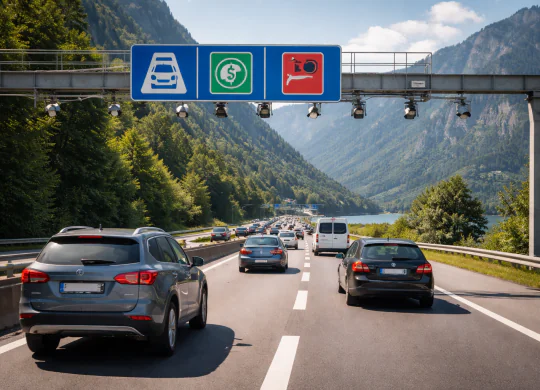
In many European countries, you can get a fine for driving on the autobahn even without contacting the police. Cameras automatically record the license plate number and check for vignettes. Find out more about the countries where drivers most often receive fines due to ignorance of the rules

In Europe, more and more countries are switching to a fully digital road payment system. A driver can drive dozens of kilometers on the highway and not see a single toll booth, but that doesn't mean the ride is free. Cameras automatically check the license plate number in the database, and the absence of a vignette is immediately recorded as a violation. This is one of the most common reasons for fines for foreigners.

Why can I get a fine without stopping the car?
In many European countries, road toll control is fully automated. The driver may not even notice the moment of violation, because there are no barriers or checkpoints on the roads. The entire system works through cameras and unified databases.
1. ANPR (Automatic Number Plate Recognition) systems read the license plate while driving and instantly check it in the database
2. Cameras are installed on highways, entrances to cities, and even on secondary roads
3. Payment is checked in real time - if there is no vignette, it is immediately recorded as a violation
4. There are no physical control points, so the driver does not receive any warning
5. The fine is generated automatically and can be sent later, even after returning to Ukraine
In some countries, the system works so accurately that a few kilometers of driving on the highway without a vignette is enough to get a fine.
What is a vignette and how does it work?
In most countries of Central and Eastern Europe, highway travel is paid for not through barriers, but with a vignette, a special permit that gives you the right to use toll roads for a certain time. In modern systems, the vignette is mostly in electronic format and is linked to a car's license plate, not to a physical medium.
After payment, the car's data is entered into a state database that is checked by cameras on the roads. If the number is not in the system or is incorrect, it is automatically recorded as a violation. The vignette is valid for a limited period - from one day to a year, depending on the country, but it is important to take into account the start date: even a few minutes before its activation is considered unpaid travel.
It is also worth considering that the vignette does not cover all roads. In some countries, there is an additional charge for using tunnels, bridges, or mountainous areas. It is because of these nuances that drivers often mistakenly believe that they have paid everything, but still receive a fine.
Don't want to miss important updates and useful articles? Subscribe to our weekly newsletter!
Slovakia: a fully electronic control system
Slovakia has one of the simplest, but at the same time the most stringent control systems. The country has completely abandoned paper vignettes - only an electronic format is used, which is linked to the license plate of the car.
Control is carried out through a network of cameras located on highways and key roads. They automatically read the license plate and check it in the database. If there is no vignette or it is not yet active, the system immediately records the violation without any warning to the driver.
An important nuance is that the vignette must be purchased before entering a toll road. Even a short drive on the highway without active payment is considered a violation. Fines start at about 100 euros and can be sent after the trip is over.
Austria: vignette and individual toll roads
Austria uses a combined tolling system that is often confusing for drivers. Vignettes are mandatory on most highways, but certain sections, such as tunnels and mountain roads, are charged additionally even if they are vignetted.
Control is carried out through both stationary cameras and mobile checks. The cameras automatically read the license plate number and check for the presence of an electronic or physical vignette, as well as the fact that special sections have been paid for. The driver does not receive any signal about the check.
Another nuance is that if you buy a digital vignette for individuals, it may not take effect immediately, but after 18 days (due to consumer protection rules). This means that many drivers drive on the highway thinking that everything is paid for and get a fine.
Fines in Austria usually start at 120 euros and can be much higher in case of additional violations or ignoring payment requirements.
Bulgaria: digital control even on ordinary roads
Bulgaria has introduced a fully electronic road payment system, where the vignette exists only in digital format. It is tied to the license plate of the car, and all checks are carried out automatically through the state monitoring system.
Cameras are installed not only on highways, but also on many intercity and even some secondary roads. This means that violations can be detected even where the driver does not expect any control. The system operates in real time: the license plate number is immediately checked in the database, and the absence of payment is recorded instantly.
Another feature is that fines are generated automatically and can be charged even for a short distance. Many drivers mistakenly believe that vignettes are only required for highways, but in Bulgaria, this rule applies much more widely.
Romania: fines that drivers learn about later
Romania has a rovinieta system - an electronic vignette that is mandatory for most national roads. It is also tied to the license plate of the car, and control is carried out through a network of cameras throughout the country.
The main feature is that the driver usually doesn't know about the violation right away. The cameras record the license plate and transmit the data to the system, after which the fine is issued and may be sent with a delay, sometimes several weeks later. Because of this, many drivers are convinced that the trip went smoothly until they receive a fine notice.
The system works automatically, and even a short drive without an active vignette is considered a violation. At the same time, repeated violations can be recorded several times, which leads to the accumulation of fines for one trip.
Czech Republic: a fine even for a few kilometers without payment
The Czech Republic has a fully electronic system of vignettes that is linked to the license plate of the car. Paper stickers are no longer used, and control is carried out through automatic cameras on highways and key road junctions.
The system works without any “grace period”. If a driver enters a toll road without an active vignette, even for a few kilometers, it is immediately recorded as a violation. The cameras read the license plate and instantly check it in the database.
Another important point is mistakes when entering the license plate number or the effective date. Even one wrong letter or number means that the car will not be found in the system, and this is equivalent to no payment. Fines can reach approximately 200 euros.
Hungary: a fine for even one mistake in the license plate
Hungary has an electronic system called e-matrica, where payment is linked to the license plate. Cameras automatically check every car on toll roads, and any discrepancy in the data is immediately recorded as a violation.
The most common reason for fines is a mistake in the license plate. Even one incorrect letter or number means that the system cannot find the car in the database. The driver may be sure that he or she has paid the toll, but in fact is considered a violator.
The fine for not having a vignette ranges from about 60 to 200 euros, depending on the payment period. If it is not paid on time, the amount can more than double.
Slovenia: one of the highest fines in the region
Slovenia uses an electronic vignette that is mandatory for all highways and expressways. Cameras and road services constantly check vehicles, and control is carried out both automatically and selectively.
The country is characterized by very high fines, even for short journeys without payment. Even transit through the country without a vignette (for example, a few tens of kilometers) is considered a full-fledged violation.
Fines can range from 300 to 800 euros, making Slovenia one of the harshest countries in this regard.
Switzerland: mandatory annual vignette even for one day
Switzerland has a unique system: there are no short-term vignettes. Drivers are obliged to buy an annual vignette right away, even if they plan to use the roads for only one day.
It is attached to the car (either in the form of a sticker or electronically), and is monitored by both cameras and traffic police. Transit drivers who are unaware of this feature are often fined.
The fine for not having a vignette is about 200 Swiss francs (~200-210 euros) plus the mandatory purchase of the vignette itself.
How to avoid fines: brief recommendations for drivers
Even in countries with strict controls, it is quite easy to avoid fines if you consider a few key points before you travel. Most violations occur not because of ignoring the rules, but because of inattention or misunderstanding of the system.
Before you leave, it is important to check whether a vignette is required in the country through which the route passes. In many cases, it must be purchased before entering the toll road, as even a few kilometers without payment is already recorded as a violation. You should issue a vignette only through official services, carefully checking the license plate and the date of validity - any mistake means no payment in the system.
You should also keep a proof of purchase, even if the vignette is electronic. If you rent a car, you need to clarify whether it is included in the price, because the driver is usually responsible for fines. And most importantly, you should not rely on the absence of barriers: in most countries, control is fully automatic, and the system does not leave violations unrecorded.
When planning a trip to Europe by car, it is important to take care of paying for toll roads in advance. A vignette allows you to legally drive on the highways of many European countries without fines and unnecessary stops. You can issue a vignette quickly and online on Visit Ukraine - it is convenient, transparent and suitable for both short trips and long journeys.

We remind you! With the arrival of spring, Ukrainians are increasingly planning trips abroad in their own cars, but this also brings a greater risk of encountering fraudsters. Find out how scams involving fake ‘Green Cards’ work, what risks this poses to drivers, and how to check the authenticity of an insurance policy before your trip.
Want to know more? Read the latest news and useful materials about Ukraine and the world in the News section.
Our recommendation for a safe and comfortable trip:
Visit Ukraine Insurance - insurance for a safe stay abroad without unnecessary expenses;
Green Card - compulsory car insurance for traveling abroad;
Visit Ukraine Tickets - book tickets for buses, trains, and airplanes to/from Ukraine and between cities around the world;
Private Lawyer service - professional legal support on visa and migration issues;
Visit Ukraine Merch - buy patriotic clothing and accessories with worldwide delivery.
© 2018-2026, Visit Ukraine. Use, copying or reprinting of materials on this site is permitted only with a link (hyperlink for online publications) to Visit Ukraine.
All rights reserved.
Recommended articles
2 min
Car insurance
Kierowcy na Ukrainie mogą mieć odmowy wypłaty odszkodowania z tytułu odpowiedzialności cywilnej za pojazd nawet po wypadku z powodu powszechnych błędów i naruszeń przepisów ruchu drogowego. Dowiedz się, w jakich przypadkach firma ubezpieczeniowa nie pokryje szkód i jak uniknąć odmowy wypłaty odszkodowania
21 mar. 2026
More details2 min
Car insurance
CTPCI to nie tylko obowiązkowy dokument dla kierowców, ale prawdziwy sposób na uniknięcie dużych strat finansowych w przypadku wypadku. Pokrywa koszty napraw, leczenia, a nawet pozwala szybciej rozwiązać sytuację bez zbędnej biurokracji. Dowiedz się więcej, jak CTPCI pomaga oszczędzać pieniądze i chroni kierowców w krytycznych sytuacjach
19 mar. 2026
More details2 min
Car insurance
Ukraińcy rzadziej ubiegają się o ‘Zieloną Kartę’: dlaczego to ogromny błąd dla kierowców?
Pomimo tego, że Ukraińcy często podróżują za granicę, popyt na ‘Zieloną Kartę’ maleje. Możliwe powody to mniejsza liczba podróży oraz niebezpieczna praktyka oszczędzania na ubezpieczeniu. Może to skutkować mandatami i znacznymi kosztami w przypadku wypadku drogowego. Dowiedz się, jakie ryzyka czekają na kierowców i jak szybko wykupić polisę online
19 mar. 2026
More details2 min
Car insurance
Jak wybrać ubezpieczenie samochodowe bez niespodzianek: 5 kluczowych kryteriów dla kierowców
Wybór ubezpieczenia samochodowego wpływa na bezpieczeństwo finansowe kierowcy w przypadku wypadku lub innych ryzyk. Dowiedz się, jak wybrać polisę bez ukrytych warunków, na co zwracać uwagę i jak unikać problemów z roszczeniami
20 mar. 2026
More details