


.gif)
Four years of invincibility: how Ukraine commemorates the beginning of the full-scale invasion on February 24, 2022
- February 24, 2022: the date that changed Ukraine forever
- War in numbers: losses, liberated territories and the cost of aggression
- National Day of Prayer: Unity, faith, and spiritual resistance
- Memory as action: how Ukrainians turn pain into recovery
- De-occupied cities of Ukraine: a journey that reveals the truth and supports communities
- Visit Ukraine: supporting the country through real action
- National merchandise as a symbol of memory and support for Ukraine
- Remembering means continuing to live and fight!
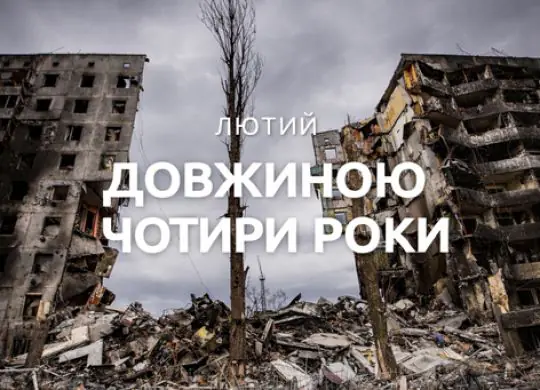
February 24 became a date for Ukraine that divided life into “before” and “after” but did not break the will to freedom. This day unites the memory of losses, gratitude to the defenders, and a common belief in victory and the restoration of the country. Learn more about how Ukrainians commemorate the beginning of the full-scale invasion and turn pain into action

February 24, 2022, was a test for every Ukrainian and at the same time the point at which a new history of national resilience began. On this day, the country faced a full-scale aggression that brought destruction, loss, pain, and death, but failed to break the desire for freedom. The memory of the first hours of the invasion, the courage of the defenders, the self-sacrifice of the rescuers, and the unity of society have turned into an internal force that helps Ukraine to hold on, recover, and move forward even in the most difficult times.
In our previous article, we described how Ukraine is turning its resources into an instrument of revival and international recognition.

February 24, 2022: the date that changed Ukraine forever
February 24, 2022 was a day that will forever be etched in the national memory of Ukrainians. Russia's full-scale invasion disrupted the usual rhythm of life for millions of people, turning the morning news into alarming reports from the front and turning quiet cities into targets for missile strikes. For the country, it was not only the beginning of the biggest test since independence, but also a moment of realization: the struggle for freedom and the right to be oneself had become a common cause for the entire nation.
This date quickly became a symbol of resilience and resistance. Ukrainians who woke up to the sounds of explosions showed their readiness to defend their homes, support each other, and not give up even in the face of a much stronger enemy. It was then that the world saw the strength of society, the determination of the Armed Forces of Ukraine, the courage of rescuers and medics, and an unprecedented wave of volunteer support that united people from different regions and countries.
The commemoration of February 24 is not only a reminder of the beginning of the full-scale invasion, but also a manifestation of deep respect for those who gave their lives for the freedom of our homeland. On this day, Ukrainians all over the country and abroad light candles of remembrance, join moments of silence, attend memorial events, and talk about the importance of preserving the truth about the war. The memory of the first days of the invasion has become part of a collective experience that reminds us that freedom has a high price, but the desire for it is stronger than fear.
War in numbers: losses, liberated territories and the cost of aggression
The statistics of a full-scale war are no substitute for human stories, but they help us see the scale of the tragedy and, at the same time, the price of resistance. These figures show not only losses and destruction, but also the results of Ukraine's defense, efforts to return prisoners, and the enormous amount of reconstruction that awaits the country. They remind us that behind every piece of equipment and every kilometer of liberated land is the human courage and daily work of thousands of people.
Losses of the Russian army and the results of Ukraine's defense
According to the General Staff of the Armed Forces of Ukraine, from February 24, 2022, to February 24, 2026, the total combat losses of Russian troops in Ukraine amounted to about 1,261,420 people. During this time, the Defense Forces destroyed 11,698 tanks, 24,086 armored combat vehicles, 37,560 artillery systems, 1,654 MLRS, 1,305 air defense systems, 435 airplanes, and 348 helicopters. The Russian Navy also suffered significant losses - 29 ships/boats and 2 submarines were destroyed. Separately, the losses of enemy UAVs of the operational and tactical level are recorded - 145,571 units, as well as 4,347 cruise missiles and almost 80 thousand units of automotive equipment and tankers.
According to the Commander-in-Chief of the Armed Forces of Ukraine, Oleksandr Syrskyi, since the end of January 2026, the Defense Forces have regained control over approximately 400 km² of territory and eight settlements on one of the directions. Earlier, more than 300 km² of liberated territory in the south of the country was reported. In addition, 2025 was the first year of the war when the Russian army's losses exceeded the level of recruitment: about 406 thousand people were mobilized during the year, while the total losses in killed and wounded reached about 418 thousand. Despite the difficult situation at the front, Ukraine managed to disrupt the enemy's large-scale offensive plans and prevent the capture of key regions.
Ukraine's losses, captivity and return home
According to the President of Ukraine, Ukraine's confirmed losses since the beginning of the full-scale invasion amount to 55 thousand killed soldiers, and a significant number of people are missing. As of February 2026, about 7,000 Ukrainian soldiers are in Russian captivity. Since February 2024, 71 prisoner exchanges have been conducted, with 6,422 military and civilians returning home, and 150 military and seven civilians were released in one of the largest exchanges in February. As of January 2026, 16,747 bodies have been returned to Ukraine as part of repatriation efforts.
Civilian victims, children and crimes against the population
According to the UN Human Rights Monitoring Mission in Ukraine, more than 15,000 civilians have been killed and more than 41,000 injured since the start of the full-scale Russian invasion. In 2025, the number of civilian deaths and injuries was 31% higher than in 2024 and 70% higher than in 2023. According to First Lady Olena Zelenska, 684 children were killed, more than 2,000 were injured, and more than 19,000 children were illegally deported or forcibly displaced by Russia during the full-scale war. As of February 2026, about 2,000 children have been returned.
Destruction of infrastructure and economic losses
As of February 2026, 1,685 cultural heritage sites and 2,483 cultural infrastructure facilities were destroyed or damaged due to Russian aggression. In addition, 4,358 educational and 2,530 medical institutions have been destroyed or damaged in the nearly four years of war. The World Bank estimates that Ukraine's direct losses amount to $195 billion, and the total cost of reconstruction and rehabilitation is almost $588 billion. In the energy sector alone, the number of damaged facilities increased by about 21%, in the transportation sector by 24%, and as of the end of 2025, 14% of housing was damaged or destroyed, affecting more than 3 million households.
Don't want to miss important updates and useful articles? Subscribe to our weekly newsletter!
National Day of Prayer: Unity, faith, and spiritual resistance
The National Day of Prayer in Ukraine has gradually gained special significance in the context of a full-scale war. For many people, it is not just a date on the calendar, but a reminder of the inner strength that helps them to survive in moments of greatest anxiety. On this day, Ukrainians turn to prayer as a form of silence, focus, and support for each other, regardless of their confessional beliefs or personal religious practices.
In the context of war, prayer has become a symbol of spiritual resistance. It does not replace real actions, but gives them meaning and depth. People pray for the defenders at the front, for rescuers, doctors and all those who work at risk every day, for families who have lost loved ones, and for those who have been forced to leave their homes. In this common appeal to faith, a sense of unity is formed - an understanding that pain and hope are common to the whole country.
The National Day of Prayer has also become a space for social unity beyond religious boundaries. People of different worldviews find it an opportunity to stop, remember the dead, and mentally support those who continue to fight for Ukraine's independence. In such moments, prayer becomes a symbol of collective support for the army, the families of the defenders, and the country itself-a quiet but deep form of solidarity that helps keep faith in the future even in the darkest periods.
In our previous article, we talked about the history of the approval of the National Flag of Ukraine.
Memory as action: how Ukrainians turn pain into recovery
For Ukrainians, the memory of the war is not limited to dates on the calendar or symbolic events. It is increasingly manifested in actions - concrete steps aimed at supporting the army, affected communities, and rebuilding destroyed cities. The pain brought by the full-scale war has not disappeared, but over time it has transformed into an internal need to be useful and to join the common cause.
One of the forms of this transformation was volunteerism, which from the first days of the invasion turned into a real movement of national unity. Thousands of people are involved in fundraising, humanitarian aid, support for military units, evacuation of civilians and assistance to affected communities. In parallel, there is a growing focus on reconstruction, both physical and social: from repairing destroyed buildings to rebuilding local communities and small businesses in regions that have experienced occupation.
Charitable initiatives, local foundations, and community projects have become an important tool for turning memory into real support. People are increasingly looking for ways not only to empathize but also to engage in the recovery process: through donations, participation in volunteer projects, or support for socially responsible initiatives. It is from this realization that interest in responsible and memorial tourism is born - forms of travel in which the main goal is not entertainment but understanding of the experience, respect for memory, and support for communities that are gradually returning to life after the occupation.
To learn more about the results of the Gradus study “Ukraine 2035: Strength, Vulnerability and Potential of the Country”, please follow the link.
De-occupied cities of Ukraine: a journey that reveals the truth and supports communities
Traveling to the de-occupied cities of Ukraine is not about “extreme experiences” or curiosity about destruction. It is a form of responsible and memorial tourism, which focuses on understanding the experience, respecting the memory of the dead, and supporting communities that are gradually returning to life after the occupation. Such trips help to see the real consequences of the war, hear the stories of people who stayed in their homes or returned after liberation, and better realize the value of the freedom that Ukraine is fighting for today.
A responsible approach to such trips includes safety and professional support. The routes are formed taking into account the current situation in the regions, and the participants are accompanied by guides who help not only with logistics but also with the correct context of what they see. An important component is that part of the proceeds from such trips are used to support local communities and restore the affected areas, so the trip becomes a form of real help, not just an observation from the sidelines.
Among the responsible tourism initiatives is Visit Ukraine's guided tour of the de-occupied cities of Ukraine, which allows you to safely see the liberated settlements, learn about the events during the occupation and the current needs of the communities.
Mykolaiv, a hero city that has withstood constant shelling and become an example of courage for the whole country, remains a separate symbol of resilience. The donation tour to Mykolaiv and the region combines familiarization with the reality of the frontline areas with support for local initiatives and assistance to the community.
Such trips foster a responsible attitude to the memory of the war: they help to see the truth without embellishment, without devaluing human pain, and at the same time support those who continue to live and rebuild their cities. This is another way to turn memory into action: quiet, dignified, and useful for the country.
Visit Ukraine: supporting the country through real action
During a full-scale invasion, every way to support Ukraine matters. And part of this support is being realized not only on the battlefield, but also through charitable initiatives, donations, and socially responsible projects. Visit Ukraine not only tells the world about the country, but also actively works to help Ukrainians in difficult times. Every day, the team processes thousands of requests (from information support to practical assistance) and does so despite the challenges of wartime.
One of the ways to join the support is to donate to the needs of Ukraine through the Visit Ukraine platform. These contributions are used to help the military, support IDPs, hospitals, and even animals that have been in the war zone or lost their homes. This form of support allows people from all over the world to make a concrete contribution to the common struggle for freedom and rebuilding the country, while remaining part of a great cause.
In addition to traditional donations, Visit Ukraine develops initiatives to support communities through tourism and travel with a charitable contribution. This is not only a way to see Ukraine in its current realities, but also a chance to directly help those who need it most. Such support combines conscious travel and charity aimed at strengthening local communities and rebuilding the country.
Every contribution, every trip and every word of support becomes part of a great common struggle for the independence, dignity and future of Ukraine. And it is this kind of real help that allows people to feel involved in the victory, even when they are not directly on the front line.
National merchandise as a symbol of memory and support for Ukraine
For many Ukrainians, patriotic merchandise has become not just an element of style, but a way to quietly and dignifiedly express their position. In times of war, symbols on clothing or accessories take on a deeper meaning: they remind us of shared values, the price of freedom, and the responsibility to be involved. Such things often become personal markers of memory: of losses, of resistance, and of the path the country is going through.
Buying Ukrainian merchandise is also a contribution to supporting the economy and social initiatives. Often, behind each item is the work of designers, manufacturers, volunteers, and charitable projects that continue to work despite the war. By choosing national merchandise, people support local teams and initiatives that channel part of the funds to help the country: from humanitarian needs to support for defenders and affected communities.
Patriotic symbols are not about loud slogans, but about the daily presence of memory in life. It helps keep those abroad connected to their homeland and serves as a sign of solidarity for foreigners who support Ukraine. In this sense, national merchandise becomes a language without words-a sign that Ukraine's pain and hope do not go unnoticed, and that support has a very concrete embodiment.

Remembering means continuing to live and fight!
For Ukrainians, the memory of February 24, 2022, is not only a reminder of pain and loss, but also a realization of their own strength. This day reminds us that freedom is not an abstract concept: those who hold the line at the front, save lives under fire, and support the country in the rear pay the highest price for it every day. Honoring the memory of the fallen is a form of gratitude and respect that at the same time strengthens the inner resolve not to give up.
Prayer, moments of silence, and joint commemorative events help to maintain a sense of unity even in times of exhaustion. For many people, this is an opportunity to stop, remember those who have not returned, and mentally support the defenders and their families. In this silence, a sense of shared responsibility for the country is born - an understanding that everyone has a role to play in preserving the memory and continuing the struggle for independence.
Memory also finds its continuation in action: in support of affected communities, in responsible travel to liberated cities, in joining charitable initiatives and community projects. Such steps help turn shared pain into shared strength, and the memory of the tragedy into a source of internal resilience. Supporting Ukrainian initiatives and socially important projects together with Visit Ukraine is another way to not only remember but also act for the country's future.
Honor the heroes of the past and support those who defend Ukraine today - purchase patriotic merchandise at Visit Ukraine!
We remind you! Ukraine is undergoing a moment of rethinking itself — a country that defends freedom while opening its culture, nature, and history to the world as a source of inspiration and strength. From art to sustainable tourism, every direction is becoming part of the global conversation about modern identity and development. Read more about how Ukraine is transforming its resources into a tool for revival and international recognition.
Want to know more? Read the latest news and useful materials about Ukraine and the world in the News section.
We recommend purchasing it for a safe and comfortable trip to Ukraine:
Visit Ukraine Insurance – insurance covering military risks for entry and travel in Ukraine;
Visit Ukraine Car Insurance – car insurance with extended coverage in Ukraine;
Visit Ukraine Legal Advice – comprehensive legal support on entry to Ukraine;
Visit Ukraine Tickets – bus and train tickets to/from Ukraine;
Visit Ukraine Tours – the largest online database of tours to Ukraine for every taste;
Visit Ukraine Hotels – hotels for a comfortable stay in Ukraine;
Visit Ukraine Merch – patriotic clothing and accessories with worldwide delivery.
© 2018-2026, Visit Ukraine. Use, copying or reprinting of materials on this site is permitted only with a link (hyperlink for online publications) to Visit Ukraine.
All rights reserved.
Recommended articles
2 min
Culture
Day of Approval of the State Flag of Ukraine: How the main symbol of the state was formed
The national flag of Ukraine is not only an official symbol, but also the embodiment of freedom, struggle and national dignity. The day it was approved was an important milestone in the history of Ukrainian statehood and self-determination. Find out more about how the blue and yellow flag came to be, what it means to Ukrainians, and why its significance is especially evident today
28 Jan. 2026
More details3 min
Culture
Kruty Heroes Memorial Day: How students became a symbol of the struggle for independence
On January 29, Ukraine honors the memory of the young men who stood up to defend the young state near the Kruty station in 1918. Their deed has forever gone down in history as an example of courage and sacrifice for freedom. Learn more about the events of the Battle of Kruty, its heroes, and the significance of this day for modern Ukraine
29 Jan. 2026
More details3 min
Events
Day of the Heavenly Hundred Heroes: the history of the feat and its significance for Ukraine today
On February 20, Ukraine honors the memory of the Heroes of the Heavenly Hundred - people who died for freedom and honor during the Revolution of Dignity. This date reminds us of the price of freedom and the choice the country has made. Learn more about the history of the Heavenly Hundred and the significance of this day for modern Ukraine
20 Feb. 2026
More details3 min
Events
The Day of Patrol and Post Service Workers and the Day of Air Navigation Service of the Armed Forces of Ukraine are an opportunity to remember the people whose daily work often goes unnoticed, but without which the country's security is impossible. It is these units that ensure order on the ground and precision in the sky, on which the lives of military and civilians depend. Find out more about those who keep Ukraine on the path to security and resilience every day
28 Feb. 2026
More details