


.gif)
Closure of the sky over the Middle East: how military operations are changing international flight routes
- Which countries have closed their airspace
- The Caucasus corridor has become a key route between Europe and Asia
- Airlines forced to extend routes
- Increased traffic in the Caucasus airspace
- Civil aviation safety remains a top priority
- How route changes affect global aviation
- Partial opening of airspace
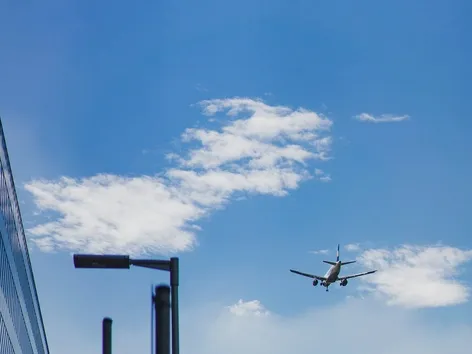
Due to the conflict in the Middle East, international airlines are changing their flight routes and concentrating flights in narrow air corridors. Find out how the closure of the skies is affecting flight times, global aviation, and routes between Europe and Asia

The escalation of hostilities in the Middle East is leading to major changes in global aviation. Due to the closure of a significant part of the airspace, international airlines are forced to change routes and concentrate flights in narrow air corridors. This affects flight duration, carrier costs, and international travel logistics.
This is reported by Business Insider, analyzing the situation based on data from aviation services and industry organizations.

Which countries have closed their airspace
Due to hostilities in the Middle East, the airspace of Iran, Iraq, Kuwait, Israel, Bahrain, Qatar, and the United Arab Emirates remains completely or partially inaccessible to civil aviation.
At the same time, russian airspace remains closed to most Western airlines — this restriction has been in effect since the start of the full-scale war against Ukraine in 2022.
As a result, international carriers found themselves in a situation where their choice of routes was significantly narrowed.
According to Flightradar24, planes are forced to either fly through narrow air corridors around the region or make long detours through Saudi Arabia and other countries. This means:
● more time in the air;
● increased fuel costs;
● increased crew costs;
● more complex international transport logistics.
The Caucasus corridor has become a key route between Europe and Asia
One of the main alternative routes for airlines has become the so-called Caucasus corridor. This refers to the airspace over Armenia, Georgia, and Azerbaijan, which currently connects Europe and Asia for transit flights.
For many global carriers, this route has become not only the most efficient, but also the only possible option. To the north lies russia, whose airspace is closed to most Western airlines due to sanctions and mutual restrictions.
At its narrowest point, the Caucasus corridor is approximately 100 miles wide, running between the airspace of russia and Iran. Without this route, airlines would have to make even longer and more expensive detours via Saudi Arabia.
Don't want to miss important updates and useful articles? Subscribe to our weekly newsletter!
Airlines forced to extend routes
Restrictions in the region have already affected flight times between Europe and Asia. For example, Finnair is adding up to four hours to its flight between Helsinki and Tokyo, and British Airways has also extended flight times on Asian routes.
These changes mean not only higher costs for airlines, but also potential delays for passengers.
If you are planning a trip in the near future, it is worth thinking about your route in advance and checking the available travel options. It is convenient to do this through the ticket booking system for all types of transport on Visit Ukraine — the service allows you to quickly find and book tickets for planes, trains, or buses in one place, which is especially useful in the context of changes in international air traffic.

Increased traffic in the Caucasus airspace
According to the Dutch association of air navigation service providers, Civil Air Navigation Services Organisation (CANSO), Azerbaijan's airspace plays a key role in providing alternative routes.
When Iran temporarily closed its airspace in June 2025, Azerbaijani airspace handled 110 more flights per day than usual.
However, the increase in traffic creates new risks. In the event of deteriorating weather conditions or further escalation of the conflict, airlines' maneuvering options could be significantly reduced.
US President Donald Trump has said that the conflict could last four to five weeks. If it spreads to the countries of Central Asia north of Iran — which experts consider unlikely — it will effectively create a continuous “wall” of closed skies.
Civil aviation safety remains a top priority
Aviation leaders emphasize that during military conflicts, civil aviation safety must remain an absolute priority.
This issue has become particularly relevant after the damage to airports in Kuwait and the United Arab Emirates as a result of missile strikes.
Willie Walsh, Director General of the International Air Transport Association (IATA), called on the parties to the conflict not to endanger civilian aircraft and to comply with international obligations to protect aviation.
His statement came against the backdrop of tragic incidents in recent years:
● In 2014, a Malaysia Airlines plane was shot down over eastern Ukraine.
● In 2020, Iranian forces shot down a Ukraine International Airlines plane near Tehran.
Both tragedies occurred against a backdrop of heightened military tensions in the regions.
How route changes affect global aviation
The rerouting of flights has already affected the airspace of other countries, including Egypt, Turkey, Saudi Arabia, and Oman. These countries have accepted dozens of additional flights.
Etihad Airways and Emirates operated a limited number of flights from the UAE, as part of the airspace was temporarily closed.
The situation is particularly difficult for Air India. The company has not used Pakistani airspace for almost a year due to political tensions. Now, with most Gulf countries closed, the carrier is forced to take even longer routes through Oman and Saudi Arabia.
Some flights make technical stops in Rome or Vienna, presumably for refueling.
Analyst Eddie Pieniazek of Ishka Advisory suggests that the widespread disruptions may be temporary and that aviation operations will gradually resume.
At the same time, the Persian Gulf region remains critical to global aviation, especially with russian airspace closed and no comparable hub infrastructure in Africa.
Partial opening of airspace
It is noted that on Monday, the airspace of the United Arab Emirates began to gradually open. Some Emirates and Etihad flights departed from Dubai and Abu Dhabi to Europe, Africa, and Asia.
At the same time, airlines urged passengers not to arrive at airports without prior flight confirmation to avoid crowding in terminals.
We remind you! The escalation of the conflict in the Middle East has affected the safety of travel to Cyprus, Egypt, and the UAE. Read what recommendations are currently in effect, whether flights are being canceled, and what risks should be considered before traveling in 2026.
Photo: Kireyonok_Yuliya / Freepik
Want to know more? Read the latest news and useful materials about Ukraine and the world in the News section.
Our recommendation for a safe and comfortable trip:
Visit Ukraine Insurance - insurance for a safe stay abroad without unnecessary expenses;
Green Card - compulsory car insurance for traveling abroad;
Visit Ukraine Tickets - book tickets for buses, trains, and airplanes to/from Ukraine and between cities around the world;
Private Lawyer service - professional legal support on visa and migration issues;
Visit Ukraine Merch - buy patriotic clothing and accessories with worldwide delivery.
© 2018-2026, Visit Ukraine. Use, copying or reprinting of materials on this site is permitted only with a link (hyperlink for online publications) to Visit Ukraine.
All rights reserved.
Recommended articles
2 min
War
The safest regions of the world: where to escape from World War III?
russia's invasion of Ukraine, the escalating conflict between the US, Israel, and Iran, and tensions between the United States and China are increasingly worrying people around the world about the threat of World War III. Find out which countries could be a safe haven for people in the event of a global war
03 Mar. 2026
More details1 min
Transport
Strike in Belgium on March 12: Brussels Airport warns of massive flight cancellations
A nationwide transport strike will take place in Belgium on March 12, affecting Brussels Airport. Find out what disruptions to expect, whether flights will be canceled, and how to prepare for changes to your travel plans
01 Mar. 2026
More details3 min
Transport
The escalation in the Middle East has caused large-scale disruptions in global aviation: thousands of flights have been canceled, key hubs in the region have been closed, and hundreds of thousands of passengers are stranded. The consequences are already being felt far beyond the region: routes are being changed, flights are being extended, and governments are preparing to evacuate citizens. Find out more about which airports and airlines have been hit hardest and what travelers should do now
03 Mar. 2026
More details1 min
Travel
Qatar extends tourist visas free of charge due to airspace closure: details
Due to the closure of airspace, the Qatari authorities have decided to automatically extend visas for foreign citizens who are unable to leave the country. Find out who is eligible for an extension, what the terms are, and what to do if your visa has expired
03 Mar. 2026
More details