


.gif)
Can children be deported without their parents: what will happen if Ukrainians lose their temporary protection in the EU

The status of Ukrainian children in the EU depends on their parents’ legal residence and does not change automatically. Find out if a child can be deported, what will happen after 2027, and how families can retain their right to reside in Europe

Thousands of Ukrainian families are concerned about their children’s future in the event that they lose temporary protection in the EU. At the same time, European legislation establishes a clear principle: the best interests of the child must be a priority, and decisions regarding a family’s status cannot be made without taking them into account. This is discussed in an article on relocate.to, which cites EU legal provisions.
Can a child be deported separately from their parents?
The key rule in the EU is that a child cannot be deported separately from their parents and does not automatically lose their status. This is enshrined in Article 24 of the EU Charter and the UN Convention on the Rights of the Child. In practice, this means that if a family finds itself in a situation of legal uncertainty, state authorities first seek to:
● keep the family together;
● legalize their stay;
● avoid separation.
At the same time, it is important to understand: if parents lose their legal status, this gradually affects the child as well—they may lose access to education, healthcare, and social benefits along with the family.
How does temporary protection work in the EU in 2026?
As of now, temporary protection for Ukrainians in the EU is valid until March 2027. During this period:
● the child is either included in the parents’ documents or has their own status;
● the right to residence, education, and medical care is usually linked to the status of the entire family.
If one parent loses temporary protection (for example, due to prolonged absence or violation of conditions), the other parent with valid status retains the child’s right to stay. If both parents lose protection, the state first offers voluntary return and may consider forced removal only after a risk assessment. Deportation is used only as a last resort.
Don't want to miss important updates and useful articles? Subscribe to our weekly newsletter!
What will change after 2027?
The European Union is already preparing for the gradual phasing out of the temporary protection regime—the so-called “coordinated exit.” Two scenarios are possible for families:
1. Transition to another legal status. If parents obtain a work residence permit or a family residence permit in time, the children automatically transition with them as family members. In this case, access to school is maintained, medical coverage remains in effect, social support is preserved, and the prospect of a long-term residence permit or citizenship opens up.
This is precisely where it is crucial not to waste time. In many cases, families should consult with specialists in advance to ensure they change their status correctly. For example, immigration lawyers at Visit Ukraine help Ukrainians prepare documents, choose the best legalization option, and avoid the risks of losing their status.

2. Loss of status with no alternative. If, after 2027, parents do not obtain a new status and remain undocumented, the child will gradually lose access to education and healthcare along with them; the family may be included in voluntary return programs, and in extreme cases, the entire family may be deported.
Important: A child does not automatically receive EU citizenship, even if the parents lose their temporary protection. This is a separate and lengthy process.
What is the situation like in different EU countries?
In most European countries, the approach to children is similar—they strive to protect them as much as possible:
● Germany — the child remains with the parents if at least one has valid status;
● Poland — the child’s derived status applies, with the option to complete the school year;
● Czech Republic — alternatives are available through Lex Ukraine or a family residence permit;
● Spain, Italy, Belgium — priority is given to education and family unity.
In all cases, the risk of family separation is assessed as low, and decisions are made with the child’s best interests in mind.
Which children receive the most protection?
European countries pay special attention to the child’s age and level of integration. The most protected categories:
● Children under 3 years of age — are considered particularly vulnerable and almost always remain with their parents;
● Schoolchildren — often have the opportunity to complete the school year even if the family’s status changes;
● Integrated teenagers — have the strongest legal standing.
The longer a child has lived in the country (attending school, knowing the language, having social connections), the greater the chances of avoiding deportation. In such cases, courts consider Article 8 of the European Convention on Human Rights (the right to family life) and Article 24 of the EU Charter.
The main thing to understand is that a child will not be left unprotected on their own, but their status directly depends on their parents’ status. Therefore, the key task for families is not to wait for temporary protection to expire, but to identify possible options for legalization in advance, apply for a different type of residence permit, and check their documents and stay periods.
We remind you! Rules regarding access to healthcare for Ukrainians are gradually changing in EU countries. Read about which medical services for refugees in Europe remain free, and what you increasingly have to pay for yourself.
Photo: alexbrod89 / Freepik
Want to know more? Read the latest news and useful materials about Ukraine and the world in the News section.
Our recommendation for a safe and comfortable trip:
Visit Ukraine Insurance - insurance for a safe stay abroad without unnecessary expenses;
Green Card - compulsory car insurance for traveling abroad;
Visit Ukraine Tickets - book tickets for buses, trains, and airplanes to/from Ukraine and between cities around the world;
Private Lawyer service - professional legal support on visa and migration issues;
Visit Ukraine Merch - buy patriotic clothing and accessories with worldwide delivery.
© 2018-2026, Visit Ukraine. Use, copying or reprinting of materials on this site is permitted only with a link (hyperlink for online publications) to Visit Ukraine.
All rights reserved.
Recommended articles
2 min
For refugees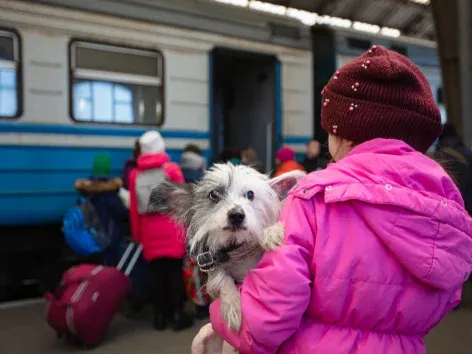
5.6 million Ukrainians are still abroad. How many of them actually plan to return?
In 2026, 5.6 million Ukrainians live far from home. While the older generation is gradually returning to their homeland, young people from large cities continue to settle in Germany and Poland. Find out how many refugees actually plan to return to Ukraine
07 Mar. 2026
More details2 min
For refugees
The European Union has already begun discussing future decisions for Ukrainians after the temporary protection expires in 2027. Find out what EU countries plan to discuss, what issues remain open, and how this may affect Ukrainians in Europe
09 Mar. 2026
More details3 min
For refugees
Will Ukrainian pensioners be able to remain in Europe after temporary protection ends in 2027?
After temporary protection ends in 2027, Ukrainian pensioners in the EU will have to switch to other grounds for residence. Find out which countries offer the best chances of staying, what mechanisms already exist, and what you should prepare in advance
11 Mar. 2026
More details3 min
For refugees
European countries are gradually changing their residency rules for Ukrainians, particularly for men of conscription age. Some countries are introducing additional checks, requiring proof of military status, or redirecting applicants to more complex asylum procedures. Find out which countries are tightening their residency requirements and who this might affect
13 Mar. 2026
More details