


.gif)
France is suspending the processing of asylum applications: what does this mean for migrants in Europe?
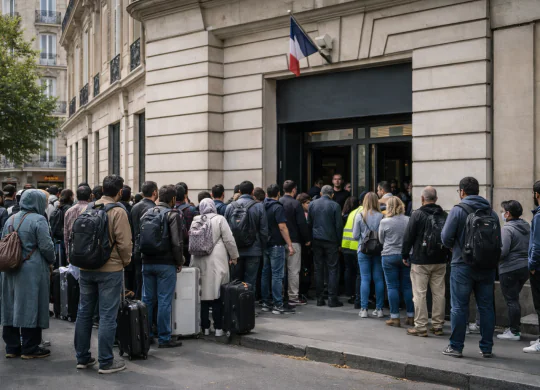
France has temporarily suspended the processing of some asylum applications, particularly those from Iranian and Lebanese nationals. The decision is due to the unstable situation in the region and the difficulty in assessing risks. Learn more about how the asylum system in Europe is changing and whether this will affect Ukrainians

France has taken a step that could set a precedent for all of Europe: the processing of some asylum applications has been temporarily suspended. This applies, in particular, to citizens of Iran and Lebanon - countries where the situation is rapidly changing, making it difficult to reach decisions.
This decision was made by the Asylum Court, which cited a high risk of errors: given the instability, it is difficult to determine whether returning a person is safe.
In a previous article, we reported that France has updated the rules for transitioning from APS to a titre de séjour via AFUCA and is introducing a new exam.
What happened, and who is affected by France’s decision?
France has temporarily suspended the processing of some asylum applications. The decision was made by the National Asylum Court and primarily affects citizens of Iran and Lebanon.
The reason is the sharp instability in these countries. The situation is changing so rapidly that government agencies cannot objectively assess the level of threat to applicants. Under such conditions, there is a risk of making the wrong decision—for example, denying asylum to a person who is actually in danger.
In effect, France has adopted a cautious approach: not to deny asylum, but also not to make a decision until the situation becomes more predictable. This means that applications are not rejected but “frozen” indefinitely.
This approach is atypical for the traditional asylum system, where each case is considered individually and within established timeframes. Now, however, geopolitical factors are coming to the forefront, directly influencing migration decisions.
Don't want to miss important updates and useful articles? Subscribe to our weekly newsletter!
Why is Europe changing its approach to asylum?
The European asylum system can no longer keep up with the pace of events. Conflicts, political crises, and humanitarian risks are changing so rapidly that the traditional model of individual case review is beginning to fail.
The main problem is the difficulty of assessing risks. If the situation in a country is unstable, a decision can quickly become obsolete. This increases the risk of errors, particularly the return of people to dangerous conditions.
In response, EU countries are gradually changing their approach:
1. They are increasingly using collective protection instead of individual decisions
2. They are placing greater emphasis on geopolitical factors rather than just the applicant’s personal history
3. They are allowing for delays or “pauses” in case processing
In effect, asylum ceases to be a swift legal procedure and becomes a process dependent on the global situation.
Learn more about opportunities for emigration to France in 2026 by following the link.
What does this mean for migrants and the EU system?
For asylum seekers, this means, above all, longer waiting times. Decisions may be postponed indefinitely, and a person’s status remains in limbo—without a clear understanding of the future.
Delays also affect daily life: it is more difficult to secure stable housing, a job, or access to a full package of social support. As a result, people are forced to remain in temporary living conditions for longer.
For the European Union, this creates additional pressure on the system:
1. Unresolved cases are piling up
2. The burden on social services is growing
3. Political tensions surrounding migration are intensifying
In the event of new waves of migration, this model may prove even less effective, as the system is already operating at its limits.
Will this affect Ukrainians?
There is currently no direct impact on Ukrainians. In EU countries, the temporary protection mechanism for Ukrainian citizens remains in effect, operating separately from the traditional asylum system.
However, indirect consequences are possible. Changes in migration policy could lead to:
1. Greater competition for housing and social resources
2. A review of support programs in certain countries
3. Increased political tension surrounding migration
It is also important to note that the EU is increasingly focusing on flexible and situational solutions. This means that rules may change more quickly, depending on the international situation.
When planning a trip or move to Europe, it is important to take care of your financial and medical security in advance. Medical insurance for Ukrainians abroad from Visit Ukraine covers the costs of treatment, emergency care, hospitalization, and other unforeseen situations that may arise while staying in another country. Purchasing a policy will help you avoid significant expenses and ensure access to quality medical care in the EU, which is especially important given the changes in migration policy.

We remind you! The special law for Ukrainian refugees has expired in Poland, but the temporary protection regime remains in effect. Read about the rules regarding stay, residence, and social assistance that will apply to Ukrainians after March 5, 2026.
Photo: zara66579 / Freepik
Want to know more? Read the latest news and useful materials about Ukraine and the world in the News section.
Our recommendation for a safe and comfortable trip:
Visit Ukraine Insurance - insurance for a safe stay abroad without unnecessary expenses;
Green Card - compulsory car insurance for traveling abroad;
Visit Ukraine Tickets - book tickets for buses, trains, and airplanes to/from Ukraine and between cities around the world;
Private Lawyer service - professional legal support on visa and migration issues;
Visit Ukraine Merch - buy patriotic clothing and accessories with worldwide delivery.
© 2018-2026, Visit Ukraine. Use, copying or reprinting of materials on this site is permitted only with a link (hyperlink for online publications) to Visit Ukraine.
All rights reserved.
Recommended articles
1 min
War
Hoodies like Zelensky's: the President's closet during the war
After February 24, the President of Ukraine changed his style, removing classic suits from his wardrobe and replacing them with ordinary comfortable clothes with patriotic symbols. Find out what dress code the president prefers and where to buy such clothes
12 May. 2023
More details3 min
Emigration
Emigration to France: how can Ukrainians move in 2026?
To successfully emigrate to France, it is necessary to determine the type of visa in advance, collect the necessary documents and research all the legal nuances. Find out more about how Ukrainians can move to France in 2026, what types of visas and residence permits are available, and how to obtain a work permit
09 Feb. 2026
More details2 min
For refugees
France tightens requirements for foreigners: new civic test introduced
Foreigners who plan to obtain a residence permit or citizenship in France will now have to take a mandatory civil exam. We explain what this test is, who it applies to, and why there has been so much criticism around it
14 Jan. 2026
More details2 min
Documents
Without bureaucratic hell: how to get a Ukrainian passport more easily if you are in France
Tired of waiting months for a Ukrainian passport in France? A legal alternative is to apply for a passport through ‘passport tourism.’ Find out how to simplify the passport application process if you live in France
19 Feb. 2026
More details