


.gif)
Why a train might be stopped during an air raid alert: an explanation from the Ministry of Defense
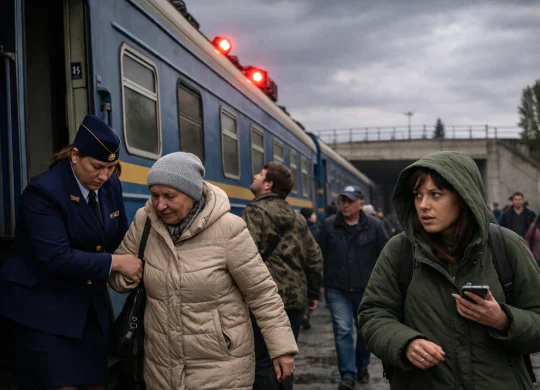
Trains in Ukraine do not always stop during an air raid alert, but in some cases it becomes necessary for passenger safety. The Ministry of Defense has explained the conditions under which the decision to halt train service and evacuate passengers is made. Learn more about the new rules and what passengers should do in such situations

Air raid alerts have become a part of everyday life in Ukraine, but not everyone understands exactly how they affect train operations. Many passengers expect trains to stop automatically during every alert, but in practice, the situation is much more complex and depends on the specific threat.
According to representatives of the Ministry of Defense, Ukrzaliznytsia is currently working in close coordination with the military and has access to airspace monitoring systems. This allows for the rapid assessment of risks and decision-making based not on formal procedures, but on the actual danger.
The new approach allows trains to either continue moving even during an alert or to stop and evacuate passengers—depending on the situation. That is why it is important to understand in which cases such measures are applied and how passengers should act correctly.

Why trains may stop during an air raid alert
An air raid alert does not in itself mean that trains will automatically stop. The decision is made based on the actual threat, not just the sound of a siren.
Ukrzaliznytsia works in coordination with the military and constantly monitors the situation in the airspace. This allows them to quickly determine whether there is a risk specifically for a particular train or route.
The main reason for a stop is not the alarm itself, but the threat of a direct strike. According to representatives of the Ministry of Defense, modern drone attacks can be unpredictable: drones sometimes change their target and may attack a train if they spot it on the route.
That is why, in certain cases, a decision is made to halt service or reroute the train. The main goal is to minimize risks to passengers, even if it means a delay or a schedule change.
In our previous article, we reported that rail service in Ukraine is operating under a new threat—targeted attacks on passenger trains.
In what cases is the decision made to stop a train?
The decision to stop a train is not made simply because of an air raid alert, but only when there is a confirmed threat to a specific route or train. Based on data from military monitoring systems, Ukrzaliznytsia assesses the situation in real time and responds depending on the level of danger.
A train may be stopped in the following cases:
1. Movement of a strike drone or other weapon has been detected near the route
2. There is a risk of an attack on railway infrastructure facilities
3. There is a probability of a direct strike on the train or its detection by the enemy
4. The drone’s trajectory is changing toward the rolling stock
5. The threat level is assessed as one that could lead to mass casualties
In such situations, the top priority is the lives of passengers. That is why even a potential danger can be grounds for an immediate stop or a change in route.
Don't want to miss important updates and useful articles? Subscribe to our weekly newsletter!
When passengers are evacuated from the train, and when they are not
The decision to evacuate depends on the threat level and how quickly it is developing. In all cases, the principle applies: minimal risk to passengers’ lives.
If the threat is assessed as critical, the train is stopped and passengers are led out of the cars. This happens when there is a real likelihood of a collision—for example, a drone is moving directly toward the train or alongside the route.
If the situation is not critical, however, no evacuation is carried out. In such cases, safety is ensured by other means—specifically, by adjusting the schedule, slowing down the train, or rerouting it to avoid the danger zone.
This approach avoids causing unnecessary stress for passengers while still allowing for a rapid response to real threats. In most cases, passengers do not even notice that the train has been diverted from a potentially dangerous section.
We previously reported that trains in Ukraine are running massively behind schedule due to drone attacks.
What happens after the evacuation of passengers
Once the decision to evacuate is made, the main task is to quickly move people to a safe location and minimize the risk of injury.
Passengers are systematically led out of the cars following the conductors’ instructions. All subsequent actions are aimed at moving people as far away as possible from the potential target—the train itself.
In such situations, it is important to act without delay and follow instructions clearly. The main rules are as follows:
1. Move at least 100 meters away from the train
2. Do not gather near the cars or tracks
3. Proceed to a shelter or safe zone as quickly as possible
4. In the event of explosions, lie face down on the ground
5. Cover your head and open your mouth to reduce the impact of the blast wave
These measures are simple to explain: a train can become a target for an attack, even if the drone was initially heading toward another object. That is why staying near the train cars during a threat is dangerous.
What passengers should do when the train stops
If the train stops due to a threat, the most important thing is not to panic and to follow the crew’s instructions quickly. Safety depends on how quickly you react. After a high-risk alert, passengers should immediately prepare to exit the car and wait for the conductor’s instructions.
Key steps to follow:
1. Get dressed quickly and gather your personal belongings
2. Take your documents, phone, and essentials
3. Notify the conductor in advance if you need assistance
4. Do not linger in the car after the evacuation order
5. After exiting, immediately move away from the train to a safe distance
It is also important to avoid common mistakes: do not go back for belongings, do not film near the train, and do not ignore staff instructions. Strict adherence to these rules significantly reduces risks even in dangerous conditions.
When planning trips within Ukraine or abroad, it is advisable to arrange financial protection in advance for unforeseen situations. War risk insurance from Visit Ukraine will help cover expenses in the event of injuries, property damage, or other consequences related to hostilities. This is particularly relevant in high-risk situations, when even a routine trip can involve additional risks.

We remind you! Ukraine is preparing to launch another important rail route. The new route to Bulgaria promises to simplify travel, reduce the burden on buses and strengthen transport integration with the EU. Find out when the service will start, what the route will be and what is known about tickets.
Want to know more? Read the latest news and useful materials about Ukraine and the world in the News section.
Our recommendation for a safe and comfortable trip:
Visit Ukraine Insurance - insurance for a safe stay abroad without unnecessary expenses;
Green Card - compulsory car insurance for traveling abroad;
Visit Ukraine Tickets - book tickets for buses, trains, and airplanes to/from Ukraine and between cities around the world;
Private Lawyer service - professional legal support on visa and migration issues;
Visit Ukraine Merch - buy patriotic clothing and accessories with worldwide delivery.
© 2018-2026, Visit Ukraine. Use, copying or reprinting of materials on this site is permitted only with a link (hyperlink for online publications) to Visit Ukraine.
All rights reserved.
Recommended articles
2 min
Popular
How to Buy a Train Ticket from Ukraine to Europe in 2026: Tips from Ukrzaliznytsia and Handy Hacks
Demand for international trains from Ukraine to Europe in 2026 remains high, so tickets sell out quickly. Find out how to buy a ticket online, when sales open, and how to use Ukrzaliznytsia’s tips
22 Mar. 2026
More details2 min
Transport
Rail services in Ukraine are operating under a new threat: targeted attacks on passenger trains. Ukrzaliznytsia is stepping up security measures, which is already leading to widespread delays and changes to transport regulations. Find out how this will affect passengers and what you need to bear in mind before travelling
24 Mar. 2026
More details2 min
Transport
Ukraine–Bulgaria Train: When Will It Begin Operating and What Will Its Route Be?
Europe is getting closer: Ukraine is preparing to launch another important rail route. The new route to Bulgaria promises to make travel easier, reduce the burden on buses and strengthen transport integration with the EU. Find out when the service will launch, what the route will be and what is known about tickets
07 Apr. 2026
More details2 min
Transport
Widespread train delays in Ukraine have affected almost all routes. This is due to attacks on infrastructure and the need to reroute services. Southern and international services have been hit hardest. Find out which trains are delayed and what passengers should do
01 Apr. 2026
More details