


.gif)
Why some insurers require detailed itineraries for Ukraine trips
- Why insurers no longer treat Ukraine as a standard travel destination
- Why itineraries became part of underwriting decisions
- The hidden layer: reinsurers and risk acceptance
- How itinerary details influence war risk insurance cost
- Why “flexible travel” creates insurance complications
- Medical evacuation and why location accuracy matters
- Compliance, sanctions, and documentation requirements
- What happens when itinerary information is incomplete or changes
- Why standard travel insurance is not enough

Insurers often ask for detailed itineraries when assessing travel to Ukraine, which can surprise travelers who expect simple policy approval. Discover why route planning, movement details, and accommodation information play a key role in issuing war risk insurance coverage

Travel insurance for Ukraine has become significantly more complex since the beginning of the full-scale war. What used to be a short online form for international coverage is now, in many cases, a structured underwriting process involving route planning, accommodation details, and even transport methods.
This change is not administrative overreach. It reflects a shift in how insurers and reinsurers evaluate exposure in active conflict environments where conditions can change rapidly and where standard statistical models no longer apply.
Learn how itinerary requirements influence war risk insurance cost, underwriting decisions, and claim validation for foreign travelers entering Ukraine.
Understanding these mechanisms is increasingly important for business travelers, journalists, NGO staff, and contractors operating in Ukraine, where insurance compliance often becomes part of operational planning rather than a separate step.

Why insurers no longer treat Ukraine as a standard travel destination
In most international markets, travel insurance is based on statistical predictability. Insurers calculate risk using historical data: accident rates, medical costs, crime levels, and transport safety indicators.
Ukraine does not fit into that model in its current conditions.
According to international insurance guidance, destinations affected by armed conflict are classified as “war risk” or “elevated risk” territories, where standard coverage is either restricted or subject to exclusions. Cornell University’s risk management framework, for example, notes that coverage in such regions often shifts to “urgent and emergency medical care only,” with additional exclusions depending on destination classification .
At the same time, standard travel insurance policies commonly exclude war-related incidents entirely. A typical wording used by international insurers states that losses “arising from war or acts of war” are not covered unless explicitly included as an extension .
This creates a structural gap: basic travel insurance exists, but it does not reliably function in conflict environments.
That gap is what war risk insurance is designed to address — and why insurers require much more detailed pre-travel information before issuing coverage.
Recommended to read: The Global Policy Trap: Why “Covered Worldwide” Often Fails in Active Conflict Zones
Don't want to miss important updates and useful articles? Subscribe to our weekly newsletter!
Why itineraries became part of underwriting decisions
When insurers request a detailed itinerary for Ukraine, they are not collecting travel preferences. They are mapping exposure.
In underwriting terms, exposure is not just where a person enters the country, but where they physically spend time, how they move, and how predictable their location is during the trip.
This matters because evacuation logistics, medical response time, and even communication reliability vary significantly across regions.
A traveler staying in Kyiv with fixed accommodation presents a different risk profile from someone moving between multiple cities with flexible arrangements. Not because one is “safe” and the other is not, but because the insurer must estimate how realistic emergency coordination would be in each case.
This is directly reflected in war risk insurance price calculations, where mobility, geography, and duration all influence final underwriting terms.
The hidden layer: reinsurers and risk acceptance
Most travelers assume insurance companies set policy conditions independently. In practice, insurers often operate within constraints imposed by reinsurers — global entities that absorb portions of catastrophic risk.
Since 2022, reinsurance capacity for Ukraine-related exposure has become limited. Several market reports and reconstruction finance initiatives indicate that international reinsurers reduced or restructured participation in Ukraine-linked risks due to uncertainty and scale of potential loss exposure.
The European Bank for Reconstruction and Development (EBRD) has also supported initiatives aimed at restoring war-risk insurance capacity in Ukraine, specifically because private market capacity alone has been insufficient to cover broader exposure needs .
In this environment, reinsurers require clearer documentation before agreeing to support policies. Itineraries become part of that requirement set because they define where exposure exists and how it can be priced and shared across the risk chain.
How itinerary details influence war risk insurance cost
The relationship between itinerary and pricing is not always obvious to travelers, but it is central to underwriting.
Insurers generally evaluate several variables when calculating war risk insurance cost:
geographic exposure (regions visited and proximity to higher-risk zones)
duration of stay
type of activity (business, humanitarian, journalistic, technical work)
transport method and internal mobility
evacuation feasibility
These factors are combined into a risk profile that determines whether coverage is offered and at what price.
For example, a short business trip limited to major western or central cities will often be priced differently from a multi-location itinerary involving industrial or infrastructure sites in more volatile regions.
The key point is not just location, but movement. Frequent or unpredictable movement increases uncertainty in emergency response planning, which directly affects underwriting cost.
Recommended to read: Is Western Ukraine "Safe Enough" for Standard Insurance Policies?
Why “flexible travel” creates insurance complications
From a traveler’s perspective, flexibility is often practical. Meetings shift, transport changes, and security conditions can evolve quickly.
From an insurer’s perspective, however, flexibility reduces predictability.
If a traveler’s location changes significantly from what was declared in the itinerary, the insurer may need to reassess whether the original risk assessment still applies.
This becomes particularly relevant during claims evaluation. Insurers typically compare declared travel plans with actual movements to determine whether exposure remained within agreed limits.
This does not automatically lead to denial of coverage, but it often leads to additional verification steps, especially in cases involving regions with elevated security sensitivity.
Medical evacuation and why location accuracy matters
One of the least visible drivers behind itinerary requirements is medical evacuation planning.
In Ukraine, evacuation logistics are not standardized. They depend on infrastructure conditions, regional accessibility, and available transport routes at the time of the incident.
Unlike in stable environments, evacuation may involve cross-regional coordination or international transfer, depending on severity and location.
This is also one of the most expensive components of war risk insurance cost, as evacuation procedures can escalate quickly in conflict environments.
Insurers therefore need accurate location data not only for pricing, but also to ensure that assistance providers can actually execute response plans under real-world conditions.
Compliance, sanctions, and documentation requirements
Insurance underwriting in Ukraine is also influenced by compliance obligations.
Insurers must operate within international regulatory frameworks, including sanctions screening, anti-money laundering controls, and reinsurance reporting requirements.
For business travelers, this sometimes results in additional documentation requests related to:
purpose of visit
business partners
industrial or infrastructure sites
transport arrangements
These requirements are not specific to Ukraine, but conflict conditions make them more detailed and more strictly enforced.
They also affect how insurance policies with war risk coverage costs are structured, since compliance obligations add operational complexity to underwriting.
Explore war risk insurance options on Visit Ukraine before planning your business trip to Ukraine.
What happens when itinerary information is incomplete or changes
In practice, most insurance complications do not come from refusal of coverage, but from mismatches between declared and actual travel.
A common scenario involves itinerary adjustments after arrival — for example, extending a stay, changing cities, or adding meetings in different regions.
If an incident occurs in a location that was not included in the original underwriting profile, insurers typically review whether the change materially affected the risk exposure.
This review process is standard in conflict-related insurance and is part of how claims are validated, not automatically rejected.
Still, it often extends processing time and increases documentation requirements.
Order war risk insurance on Visit Ukraine in advance to ensure your itinerary is properly covered before entering Ukraine.
Why standard travel insurance is not enough
Standard international travel insurance policies are not designed for conflict environments.
Most contain explicit exclusions for war, military actions, and civil unrest. Even when policies are marketed as “global coverage,” these exclusions remain active unless a specific war-risk extension is added.
As noted by major insurance providers, war-related losses are generally excluded unless explicitly included in policy wording .
This means travelers can hold valid insurance and still be uninsured for conflict-related incidents unless they have a dedicated war risk insurance policy.
Detailed itineraries are now a core part of war risk insurance underwriting for Ukraine. They are used not as a form of administrative control, but as a practical tool for assessing exposure, calculating war risk insurance price, and ensuring that evacuation and assistance systems can function in real conditions.
For travelers, especially business visitors, the key point is consistency. Insurance in Ukraine is not only about having a policy — it is about ensuring that declared travel plans align with real movement on the ground.
In a conflict environment where conditions shift quickly, that alignment becomes the basis for whether coverage works when it is actually needed.
Important reminder: traveling to Ukraine involves hidden financial risks. Standard health insurance is often not valid in this context, and emergency evacuation abroad can cost over $100,000, with these expenses typically borne by the individual. Learn how to avoid unexpected debt and what type of insurance can provide coverage for military-related risks.
Want to know more? Read the latest news and useful materials about Ukraine and the world in the News section.
We recommend purchasing it for a safe and comfortable trip to Ukraine:
Visit Ukraine Insurance – insurance covering military risks for entry and travel in Ukraine;
Visit Ukraine Car Insurance – car insurance with extended coverage in Ukraine;
Visit Ukraine Legal Advice – comprehensive legal support on entry to Ukraine;
Visit Ukraine Tickets – bus and train tickets to/from Ukraine;
Visit Ukraine Tours – the largest online database of tours to Ukraine for every taste;
Visit Ukraine Hotels – hotels for a comfortable stay in Ukraine;
Visit Ukraine Merch – patriotic clothing and accessories with worldwide delivery.
© 2018-2026, Visit Ukraine. Use, copying or reprinting of materials on this site is permitted only with a link (hyperlink for online publications) to Visit Ukraine.
All rights reserved.
Recommended articles
3 min
Travel
Affordable Vacations in Ukraine in Summer 2026: Where to Go on a Budget?
Prices for summer vacations in Ukraine in 2026 have risen by 25–40%, and popular resorts are packed. However, in the Carpathians, the Carpathian Foothills, and Transcarpathia, there are still destinations where you can enjoy a comfortable vacation without breaking the bank—with accommodations starting at 700 UAH per night. Learn more about budget-friendly summer vacation spots in Ukraine and current accommodation rates
27 May. 2026
More details2 min
War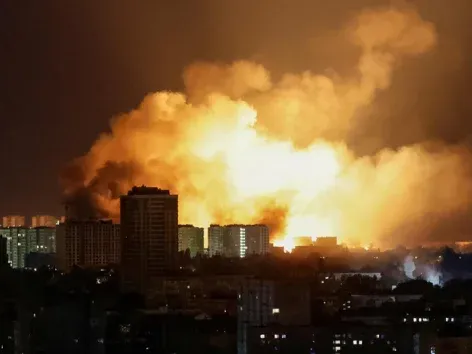
Russia is once again threatening to attack Kyiv in an attempt to sow panic following setbacks on the front line. The capital is prepared for any challenges: the air defence system is operational, and diplomats remain at their posts. Find out how safe it is to be in the city right now
26 May. 2026
More details2 min
Finance
Cash withdrawal limits in Ukraine: what bank customers need to know in 2026
Ukrainian banks continue to impose limits on cash withdrawals—both in hryvnia and in foreign currency. These limits can vary significantly depending on the bank, the type of card, and even the method of withdrawal. Learn more about the current cash withdrawal limits in Ukraine for 2026 and the terms and conditions of various banks
28 May. 2026
More details3 min
Travel
Water-based vacations in Ukraine in 2026: rivers, lakes, and hot springs instead of the sea
For the fourth year in a row, Ukrainians have been looking for alternatives to seaside vacations within the country—and there are actually more options than you might think. The mountain rivers of the Carpathians, the thermal resorts of Zakarpattia, the lakes of Volyn, and the picturesque banks of the Dnipro are more than capable of replacing the traditional beach season. Learn more about the best places for a waterfront getaway in Ukraine in 2026
29 May. 2026
More details