


.gif)
Karta pobytu for Ukrainian refugees: how to get a temporary residence permit in Poland in 2026? (updated)
- What is a Residence Card (Karta pobytu)?
- What types of residence cards are available in 2026?
- What benefits does the Residence Card provide?
- Who is eligible to apply for a Residence Card in 2026?
- CUKR Card: The Main Innovation of 2026
- Transition to fully electronic submission via MOS v2.0
- Standard procedure for applying for a residence card in Poland
- When can a Residence Card be denied?
- What is important for Ukrainians in Poland to consider in 2026?
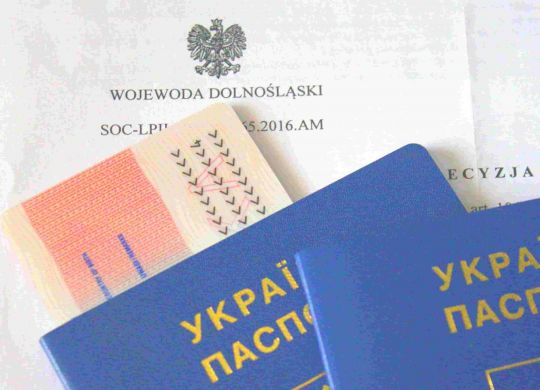
Citizens of Ukraine in Poland who have a PESEL number with the status of UKR can obtain a temporary residence permit (Karta pobytu). Find out more about what is required to obtain the document in 2026

In 2026, Poland remains one of the key destinations for Ukrainians who have relocated due to Russia’s full-scale invasion. Temporary protection for Ukrainian citizens has been extended until March 4, 2027, and as of March 5, 2026, amendments to the Special Act have come into effect, bringing Ukrainians’ rights in line with the rules for other foreigners. At the same time, for those planning to stay in Poland long-term, the Residence Card (Karta pobytu) is available—a document that legalizes the long-term stay of foreigners in the country.
2026 brought the most significant reform of the legalization procedure in recent years—a full transition to electronic submission via the MOS v2.0 system and the introduction of a separate CUKR card for PESEL UKR holders.
What is a Residence Card, what types are available in 2026, what benefits does it offer, and how to apply for it—detailed instructions follow.
Need help with migration issues?
Get professional support from Visit Ukraine lawyers!

What is a Residence Card (Karta pobytu)?
A Residence Card is a permit for long-term temporary or permanent residence in Poland, which allows a foreigner to enjoy most of the same rights as Polish citizens and to cross the state border without needing a visa.
The document contains the holder’s personal and biometric data, a black-and-white photo, the registered address of residence, the PESEL number, and conditions for access to the labor market.
What types of residence cards are available in 2026?
Ukrainians in Poland can apply for one of the following documents:
1. Temporary residence permit (karta czasowego pobytu) — issued for a period of 1 to 3 years with the possibility of renewal. It grants the right to legal residence in Poland, work, study, medical care, and other rights. Grounds for issuance: employment, business operations, study, family reunification.
2. CUKR Card (new as of 2026) — a special residence card marked “Poprzednio posiadał ochronę czasową” (previously had temporary protection), created exclusively for Ukrainians with PESEL UKR status. Issued for 3 years; applications open on May 4, 2026. See the separate section below for details.
3. Permanent Residence Permit (karta stałego pobytu) — issued for a period of 10 years with the possibility of renewal. Grounds: Polish Card, marriage to a Polish citizen (at least 3 years of marriage and 2 years on a temporary residence card), Polish origin, residence in Poland for 5 years on a temporary residence card, refugee status.
4. EU Long-Term Resident Card (zezwolenie na pobyt rezydenta długoterminowego Unii Europejskiej) — issued to individuals who have resided legally and continuously in Poland for 5 years and have a stable source of income. Requires proof of Polish language proficiency at the B1 level.
Important! Poland is changing the rules of the “800+” program.
What benefits does the Residence Card provide?
Obtaining a Residence Card provides the following benefits:
1. Legal residence in Poland for an extended period without the need to renew a visa.
2. The right to multiple entries into and exits from the country.
3. The right to stay in Schengen Area countries for up to 90 days within any 180-day period.
4. The right to work, study, obtain health insurance, and receive social assistance in Poland.
5. The ability to open bank accounts and take out loans (including mortgages).
6. The right to purchase real estate and vehicles.
7. The ability to apply for visas at U.S. and U.K. embassies from within Poland.
8. Counting the period of residence toward the residency period required to obtain EU long-term resident status.
Don't want to miss important updates and useful articles? Subscribe to our weekly newsletter!
Who is eligible to apply for a Residence Card in 2026?
The following individuals are eligible:
● Foreigners officially employed in Poland under an employment contract.
● Entrepreneurs who have established a business in Poland (LLC or sole proprietorship).
● Students and pupils of Polish educational institutions.
● Individuals reuniting with their families in Poland.
● Blue Card holders — highly qualified specialists in IT, science, medicine, engineering, etc.
● Spouses of Polish citizens or foreigners with permanent residence status.
● Ukrainians with PESEL UKR status — to apply for a CUKR card through a separate procedure.
For detailed information on how foreigners can legalize their stay in Poland online in 2026 — click here.
Who CANNOT apply for a Residence Card?
Ukrainians who meet the following criteria cannot apply for a Residence Card:
● Have been granted refugee status in another EU country.
● Hold a permanent residence permit in Poland.
● Are residing in Poland illegally.
● Are listed as undesirable foreigners in Poland or in the Schengen Information System.
CUKR Card: The Main Innovation of 2026
In 2026, Ukrainians with PESEL UKR status will have a simplified path to legalization—the CUKR residence card. This is not an alternative but a voluntary transition from temporary protection status to a full-fledged residence permit.
When applications open: May 4, 2026. The application period will run until March 4, 2027—until the end of temporary protection in the EU.
Card validity: 3 years.
Eligibility requirements:
● Ukrainian citizenship or status as a family member of a Ukrainian citizen.
● Active PESEL UKR status at the time of application.
● Continuous UKR status for at least 365 days.
● Complete data in the PESEL UKR registry: first name, last name, date and place of birth, gender, citizenship, valid foreign passport details, fingerprints (or confirmation that they cannot be taken), electronic signature sample (for persons aged 12 and older).
● No objections from state security services.
● Children will also be eligible for a CUKR card—both those arriving from Ukraine and those born in Poland (provided the mother has UKR status or has already received a CUKR card).
Cost:
● Stamp duty—340 zł (payable upon submission of the application).
● Plastic card production — 100 zł (paid after a positive decision).
Access to the MOS system for submitting an application is free, with no need to involve intermediaries.
Remember! PESEL UKR in Poland must be updated by August 31, 2026.
How to apply for a CUKR card?
Applications are submitted exclusively online via the updated MOS (Moduł Obsługi Spraw) portal. Procedure:
1. Create a new account in the MOS v2.0 system (even if you already had an account in the old version—a new one is required).
2. Log in via login.gov.pl using a Trusted Profile (Profil Zaufany), a qualified electronic signature, or a personal signature.
3. Fill out the electronic application—personal information, passport details, etc.
4. Upload a digital photo and proof of payment of the stamp duty.
5. Sign the application electronically.
6. Submit it to the provincial office in your place of residence.
After submission, the applicant receives a UPO—official confirmation of submission—and can download the application in PDF and XML formats. You will only need to visit the provincial office once—to pick up the finished card.
Ukrainians in Poland will be able to apply for a CUKR card starting May 4, 2026. We explain what you need to know in this article.
Important after receiving the CUKR:
● UKR status is automatically revoked—along with it, the special benefits under the Special Act are lost (including free medical care from the NFZ at the state’s expense).
● Health insurance will henceforth be paid through ZUS—provided you are employed.
● You must notify the voivode of a change of residence within 15 business days.
● Leaving Poland for more than 6 months or failing to collect the ready card within 60 days will result in the cancellation of the permit.
Transition to fully electronic submission via MOS v2.0
Another key change in 2026: as of April 27, 2026, the Office for Foreigners will officially stop accepting paper applications for temporary and permanent residence permits, as well as for EU long-term resident status.
All legalization will take place exclusively in digital format via the updated MOS v2.0 portal. Documents sent by mail after April 26 will be considered not submitted—the system relies on the date of actual receipt of the digital application, not the postmark.
To submit an application, you need a Trusted Profile (Profil Zaufany) or a qualified electronic signature. Correspondence with the provincial office is also shifting to an electronic system—e-Doręczenia.
Standard procedure for applying for a residence card in Poland
For a standard temporary residence card, the application package is submitted online via MOS to the provincial office (Urząd Wojewódzki) in the place of residence. Processing takes 3 to 12 months—in large provinces, such as Mazovia or Lesser Poland, the process may take up to a year; in smaller ones, it is faster.
Fees in 2026:
● Stamp duty (opłata skarbowa) for processing a temporary residence card — 440 zł.
● Stamp duty for a permanent residence card — 640 zł.
● Plastic card — 100 zł (payable after a positive decision).
Important: The stamp duty is non-refundable in case of rejection.
Document package for a standard residence card in Poland
General list:
● Application (Wniosek) in 2 copies in Polish — to be completed online via the MOS system.
● 4 photos, 3.5 × 4.5 cm in size.
● International passport and a photocopy thereof.
● Document certifying the basis for obtaining a residence card.
● Proof of residence in Poland (meldunek or other confirmation).
● Bank account statement.
● Lease agreement or proof of ownership.
● Receipt for payment of the stamp duty.
● Health insurance policy.
Additionally, depending on the basis:
For employed individuals:
● Employment contract with the employer.
● Appendix No. 1 — an appendix signed by the employer (in 2026, only in electronic form, with a trusted or qualified signature). The employer has 30 days to sign it — if the deadline is missed, the application is blocked.
● Proof of payment of taxes and contributions to ZUS.
For entrepreneurs:
● Income statement.
● ZUS contribution declaration (Deklaracja rozliczeniowa).
● Business registration documents (CEIDG, KRS).
For students and schoolchildren:
● Certificate of enrollment at a Polish educational institution.
● Bank statement confirming available funds (typically at least 10,000 zł per student, parent, or guardian).
● Health insurance policy (may be ZUS insurance).
For Blue Card holders:
● University degree or diploma, or an employment record book confirming at least 5 years of work experience in the relevant field.
● Proof of salary level.
● Document confirming qualifications.
● Employment contract with an employer for a term of at least 1 year.
When can a Residence Card be denied?
Grounds for denial:
● Failure to meet the criteria for any of the applicant categories.
● Submission of false or incomplete information and documents.
● Inclusion on the list of foreigners undesirable in Poland or in the Schengen Information System.
● Illegal stay, outstanding debts, or being in custody.
● For CUKR — incomplete data in PESEL UKR (lack of fingerprints, electronic signature, or passport details).
● Failure to pay the stamp duty or the card issuance fee.
What is important for Ukrainians in Poland to consider in 2026?
For most holders, the PESEL UKR is automatically extended. However, those who received a number without presenting a valid foreign passport are required to confirm their data at the office by August 31, 2026—otherwise, starting September 1, their status will change to NUE (illegal stay).
For those planning long-term legalization, it is important to understand: the period on the CUKR card counts toward the residency period required to obtain EU resident status, but the count begins from the date the CUKR was issued, not from the start of your stay in Poland with UKR status. This is important when planning next steps—specifically, taking the B1-level Polish language certification exam required for EU residency.
What should migrants keep in mind?
Even with sufficient income, much depends on legal status, the type of residence permit, and employment conditions. Errors in documentation or the wrong type of permit can lead to loss of income or additional expenses.
The immigration lawyers at the Visit Ukraine portal help you navigate the legalization of your stay and work in Poland so that your financial plans align with real-world conditions.
👉 Schedule a consultation to assess your options and avoid document issues before they arise!
Reminder! For Ukrainians traveling to Ukraine via Poland, it is important to check your documents and residency status in advance. What Ukrainians need to know before traveling to Poland in 2026 — find out more at the link.
Want to know more? Read the latest news and useful materials about Ukraine and the world in the News section.
Our recommendation for a safe and comfortable trip:
Visit Ukraine Insurance - insurance for a safe stay abroad without unnecessary expenses;
Green Card - compulsory car insurance for traveling abroad;
Visit Ukraine Tickets - book tickets for buses, trains, and airplanes to/from Ukraine and between cities around the world;
Private Lawyer service - professional legal support on visa and migration issues;
Visit Ukraine Merch - buy patriotic clothing and accessories with worldwide delivery.
© 2018-2026, Visit Ukraine. Use, copying or reprinting of materials on this site is permitted only with a link (hyperlink for online publications) to Visit Ukraine.
All rights reserved.
Recommended articles
2 min
Documents
Poland Launches MOS 2.0: How Foreigners Can Legalize Their Stay Online in 2026
Poland is launching the new MOS 2.0 system for the online legalization of foreigners. Find out how to submit documents remotely, what the requirements are, and what will change for Ukrainians in 2026
15 Apr. 2026
More details3 min
Entry rules
What Ukrainians need to know before traveling through Poland: an important checklist
Ukrainians traveling to Ukraine via Poland should check their documents and residency status in advance. Learn more about the basic requirements to avoid problems at the border
03 Apr. 2026
More details2 min
For refugees
Ukrainians in Poland can apply for a CUKR card: what you need to know
Poland will begin accepting applications for the CUKR card from Ukrainians as early as spring 2026. Find out who is eligible to apply, what important dates to keep in mind, and how to avoid missing deadlines
05 May. 2026
More details2 min
Finance
Poland is revising the “800+” program: payments may be automatically extended starting in 2027
Poland plans to revise the “800+” program and introduce automatic renewal of payments. Find out when the new rules will take effect, what will change for recipients, and whether they will need to submit applications every year
25 Apr. 2026
More details