


.gif)
Ukraine is on the verge of a demographic catastrophe: what is happening to the country's population
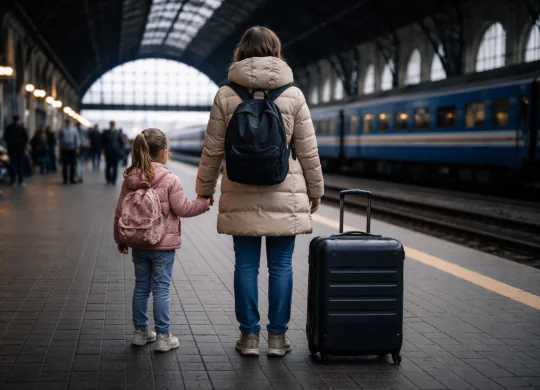
The war has dramatically accelerated demographic processes that have been brewing for years in Ukraine: mass migration, falling birth rates, and rapid population aging. The consequences of these changes are already being felt in the economy, social sphere and labor market. Find out more about why Ukraine is on the verge of a demographic catastrophe and what it could lead to

The full-scale war was not only a humanitarian and security disaster for Ukraine, but also a powerful blow to its demographic future. In a short period of time, the country lost millions of people to deaths at the front, forced migration, and occupation of territories, and the birth rate dropped to critically low levels. At the same time, the proportion of elderly people is rapidly increasing, while the working-age population is declining. All of this creates long-term risks for the country's recovery from the war and jeopardizes economic stability and social systems.
Falling birth rates and population losses
The war has sharply deepened the demographic crisis in Ukraine, which had already been forming for years. The full-scale invasion caused large-scale human losses, a collapse in the birth rate, and serious changes in the age structure of the population. All of this is already having long-term consequences for the country's economy, labor market, and social system.
How many people did Ukraine lose because of the war?
Leading Ukrainian demographers estimate that Ukraine has lost about 10 million people since the beginning of the full-scale invasion. This includes not only those who died at the front, but also people who were forced to leave their homes, ended up in the temporarily occupied territories, or went abroad. In fact, in a few years, the country has lost a portion of its population comparable to that of a large European country.
Don't want to miss important updates and useful articles? Subscribe to our weekly newsletter!
A record drop in the birth rate
At the same time, the birth rate has plummeted. The number of children born among Ukrainians during the war fell to less than one child per woman. For comparison, the average rate in Europe is about 1.4, and in the United States it is about 1.6 children per woman. This level of fertility means that even in the absence of migration, the country's population would not be replenished naturally.
The decision to have children is directly affected by the conditions of war. Constant stress, threats to life, instability of income and housing, and a lack of security force many families to postpone starting a family indefinitely.
Widows and orphans as a new social reality
Another painful consequence of the war was the sharp increase in the number of children who lost one or both parents. Most of the soldiers killed at the front had families and children. As of today, about 59,000 children in Ukraine live without biological parents, mostly in foster care. At the same time, a new social reality is emerging: communities of young widows who unite to support each other, help the children of the fallen, and preserve the memory of their loved ones.
In our previous article, we looked at the Top 5 cities in Ukraine where prices for one-bedroom apartments rose the most in 2026.
Mass migration of Ukrainians abroad
Mass migration of Ukrainians outside the country has become one of the most powerful factors in the demographic crisis. Due to the full-scale war, millions of people were forced to seek safety abroad, and the risk of their non-return is only increasing every year. This creates not only a demographic but also a serious economic problem for Ukraine.
According to official data from international organizations, about 6 million Ukrainians are registered as refugees abroad. The vast majority of them are women and children. It is these groups that form the future demographic potential of the country, so their prolonged absence directly affects the birth rate and population structure within Ukraine.
The longer the war lasts, the less likely it is that all IDPs will return home. Some Ukrainians are gradually integrating into the economy and social life of other countries, finding jobs, housing, and enrolling their children in schools and kindergartens. Over time, returning to Ukraine ceases to be an obvious solution for many, especially if security and stability issues remain.
Mass migration also has direct economic consequences. After the war ends, Ukraine will need skilled labor to rebuild its infrastructure, businesses, and government institutions, but a large portion of the working population may remain abroad. Coupled with a decline in the birth rate, this creates the risk of a long-term labor shortage and a slowdown in economic recovery.
In our previous article, we explained that Ukrainians who were forced to go abroad because of the war can apply for moral compensation.
Population aging and demographers' forecasts
The demographic crisis in Ukraine is not limited to population loss and migration. It is also manifested in the rapid aging of the nation and the decline in the number of people of working age. These processes were already underway before the war, but the full-scale invasion significantly accelerated the negative trends.
Even before 2022, Ukraine was on the list of countries with high rates of population aging. The proportion of people aged 65 and older increased from 12% in 1991 to 18% in 2021, and reached 22% in 2024. This growth means that almost one in five people in the country is of retirement age, which significantly increases the burden on the social security and healthcare systems.
At the same time, the number of people of working age has sharply decreased. Due to demographic changes and the effects of the war, the number of working-age people in Ukraine has decreased by about 40% compared to pre-war 2021. This means a shortage of labor in key sectors of the economy and serious limitations for the country's post-war recovery.
Demographers' forecasts for the future population of Ukraine remain worrisome. Experts estimate that in the absence of systemic changes and large-scale population support programs, the population could decline to 28.9 million by 2041, and to 25.2 million by 2051. According to Ella Libanova, director of the Mykhailo Ptukha Institute for Demography and Quality of Life Studies, only about 28-30 million people live in the government-controlled areas.
When planning a trip to Ukraine or abroad, it is important to take care of medical protection in advance in case of unforeseen situations. Medical insurance from Visit Ukraine helps you to get access to the necessary assistance in case of illness, injury or emergency by covering medical consultations, treatment and hospitalization in accordance with the terms of the policy. It is an easy way to reduce financial risks and feel more relaxed while traveling!

We remind you! The Czech Republic is tightening the conditions for Ukrainians to obtain long-term residence and is focusing on economic independence. Find out what new requirements the government is setting and who will be eligible for special status.
Want to know more? Read the latest news and useful materials about Ukraine and the world in the News section.
Our recommendation for a safe and comfortable trip:
Visit Ukraine Insurance - insurance for a safe stay abroad without unnecessary expenses;
Green Card - compulsory car insurance for traveling abroad;
Visit Ukraine Tickets - book tickets for buses, trains, and airplanes to/from Ukraine and between cities around the world;
Private Lawyer service - professional legal support on visa and migration issues;
Visit Ukraine Merch - buy patriotic clothing and accessories with worldwide delivery.
© 2018-2026, Visit Ukraine. Use, copying or reprinting of materials on this site is permitted only with a link (hyperlink for online publications) to Visit Ukraine.
All rights reserved.
Recommended articles
2 min
War
First Since 2023: Ukraine Recaptures Hundreds of Kilometers in Counteroffensive
American experts are recording the Ukrainian army's greatest success in the last two years. While Russian defences are crumbling due to a technological blockade, Kyiv is effectively seizing the moment to reclaim its territories in the east. Learn about the real scale of the Ukrainian Armed Forces' advance
17 Feb. 2026
More details3 min
War
February 24 became a date for Ukraine that divided life into “before” and “after” but did not break the will to freedom. This day unites the memory of losses, gratitude to the defenders, and a common belief in victory and the restoration of the country. Learn more about how Ukrainians commemorate the beginning of the full-scale invasion and turn pain into action
24 Feb. 2026
More details2 min
For refugees
Temporary protection in the EU: why 5 years of residence does not guarantee permanent status
Many Ukrainians in the EU expect that five years of temporary protection will automatically open the way to permanent residence, but the reality is different. The legal intricacies of European directives and the lack of a single agreement between countries call into question the usual mechanisms of legalisation. Find out what conditions Poland, Germany and other EU countries are actually preparing for those who plan to build their future in Europe
24 Feb. 2026
More details2 min
War
Ukrainians who were forced to leave the country due to the war can submit an application to the International Register of Damages in a new category. Find out who is eligible to apply, how to submit an application through “Diyu,” and what will happen next
25 Feb. 2026
More details