


.gif)
Ukraine-Hungary tensions rise: Ukrainians urged to avoid travel. What's behind the conflict?
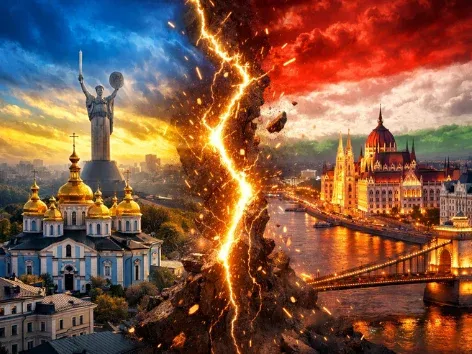
A diplomatic conflict has resulted in hostage-taking and millions of euros! Budapest has crossed all red lines: from oil blackmail to the arrest of Ukrainian debt collectors. The Ukrainian Foreign Ministry urgently urges citizens not to travel to the neighbouring country. Find out what preceded this and how the situation is developing now

Against the backdrop of an unprecedented deterioration in diplomatic and economic relations, the Ukrainian Ministry of Foreign Affairs has issued an official warning: citizens are strongly advised to refrain from any travel to Hungary. This decision was preceded by a series of ultimatums, energy blackmail and an incident that Kyiv directly refers to as ‘kidnapping and hostage-taking’.
How did the two neighbouring countries reach this boiling point?
The foundations for the current crisis were laid at the beginning of Russia's full-scale invasion of Ukraine. While most European countries took a course of action to abandon Russian energy resources, Viktor Orbán's government chose a different strategy. Budapest continued to purchase oil directly from Russia, maintained business ties with the aggressor country, and regularly echoed the Kremlin's rhetoric, while simultaneously slowing down or blocking European aid packages to Kyiv.
The apple of discord: the attack on the Druzhba oil pipeline
Russia provoked a new round of conflict by attacking one of the largest reservoirs of the Ukrainian section of the Druzhba oil pipeline with a drone on 27 January. According to the Ukrainian government, there were 25,000 cubic metres of oil there at the time of the strike, and damage to the internal equipment made it impossible to pump it out completely. Budapest and Bratislava refused to acknowledge Russia's guilt, and Viktor Orbán stated that satellite images allegedly did not show any damage, blaming Kyiv for the transit stoppage. In response, Foreign Minister Andriy Sybiga published photographs of the consequences of the direct strike and advised the Hungarian authorities to ‘open their eyes.’
Due to the transit stoppage, Hungary resorted to outright political pressure, blocking the allocation of a €90 billion loan to Ukraine from the EU. President Volodymyr Zelensky noted that the technical capability of the pipeline could be restored in about a month and a half, but Budapest made this a strict condition for unblocking European funds.
Orbán's ultimatums and threats of a transport blockade
The tension resulted in open threats from the Hungarian prime minister. In an interview with Kossuth Radio, he called Ukraine's inability to immediately resume oil transit ‘state banditry’ and threatened to use force to ‘break the Ukrainian oil blockade.’
Orbán announced that petrol and diesel supplies had already been halted and threatened to block the transit of goods important to Ukraine.
He categorically added that Hungary would not give up Russian oil, would not give money for the war, would not let Ukraine into the EU, and that Ukraine would sooner be left without money than Hungary without oil.
Provocation with Oschadbank cash collectors
The point of no return was passed on the night of 6 March, when the Hungarian authorities unjustifiably stopped and detained two cash collection vehicles belonging to the Ukrainian state-owned Oschadbank. The vehicles were on a regular trip from Austria to Ukraine, carrying enormous assets: $40 million and €35 million in cash, as well as 9 kilograms of bank gold.
Seven employees of the cash collection team, all Ukrainian citizens, were detained. According to Andriy Sybiga, the Hungarian authorities effectively took them hostage. It later emerged that the stolen armoured vehicles had been hidden on the premises of the Hungarian Anti-Terrorist Centre, which is subordinate to the local Ministry of Internal Affairs.
Don't want to miss important updates and useful articles? Subscribe to our weekly newsletter!
Ukraine reacted harshly
In response to these actions, the Ukrainian Foreign Ministry recommended that Ukrainians refrain from travelling to Hungary due to the inability to guarantee their safety against the backdrop of arbitrary actions by the Hungarian authorities and the theft of state bank property. The conflict, which began as an energy dispute over Russian attacks on infrastructure, escalated into open confrontation with the forceful seizure of people and state funds.
Conflict with prisoners of war
The day before the incident with the cash collectors, Russia handed over captured Ukrainian Armed Forces soldiers from Zakarpattia to Hungary on the condition that they record a propaganda video praising the aggressor country.
In conditions of armed conflict and mass unrest, health risks increase many times over. We remind you that having a reliable insurance policy is not a formality, but your financial security in an emergency.
You can purchase medical insurance covering a wide range of risks online at the Visit Ukraine portal. This will provide you with access to qualified assistance and support 24/7, which is especially critical when public transport is suspended and roads are blocked.

Reminder! New customs requirements in Hungary will affect all Ukrainian carriers working with the EU. From 18 February 2026, the submission of a General Declaration of Arrival (ENS) via the ICS2 system will become mandatory. Find out how to avoid delays and fines at the border.
Want to know more? Read the latest news and useful materials about Ukraine and the world in the News section.
Our recommendation for a safe and comfortable trip:
Visit Ukraine Insurance - insurance for a safe stay abroad without unnecessary expenses;
Green Card - compulsory car insurance for traveling abroad;
Visit Ukraine Tickets - book tickets for buses, trains, and airplanes to/from Ukraine and between cities around the world;
Private Lawyer service - professional legal support on visa and migration issues;
Visit Ukraine Merch - buy patriotic clothing and accessories with worldwide delivery.
© 2018-2026, Visit Ukraine. Use, copying or reprinting of materials on this site is permitted only with a link (hyperlink for online publications) to Visit Ukraine.
All rights reserved.
Recommended articles
2 min
Popular
Due to the conflict in the Middle East, international airlines are changing their flight routes and concentrating flights in narrow air corridors. Find out how the closure of the skies is affecting flight times, global aviation, and routes between Europe and Asia
08 Mar. 2026
More details2 min
Popular
Against the backdrop of the US and Israeli operation, Tehran is launching unpredictable drone strikes on neighbouring countries — today, drones reached Azerbaijan, where civilian infrastructure has already been damaged. The situation is escalating every day. Find out what safety rules will help tourists in an emergency
05 Mar. 2026
More details1 min
Popular
Lviv is transitioning to an enhanced security regime: what do residents and tourists need to know?
Enhanced security measures will be implemented in Lviv from March 5 to 9 with the participation of the Security Service of Ukraine, the National Police of Ukraine, and the National Guard of Ukraine. Find out why they are being implemented, what restrictions are possible in the city, and what residents and tourists need to know
06 Mar. 2026
More details2 min
Finance
Sweden advises keeping cash on hand in case of crisis or war: what you need to know
Sweden, one of Europe's most digitized economies, is urging citizens to keep cash on hand in case of crisis or war. Find out how much money they advise keeping at home, why it is important to use different payment methods, and how to prepare for possible disruptions in payment systems
06 Mar. 2026
More details