


.gif)
Civic Tests for EU Citizenship in 2026: What Has Changed and How Ukrainians Can Prepare
- Complication of the procedure for obtaining citizenship in Europe is the main trend of 2026
- Poland: The main requirement is a high level of language proficiency
- Czech Republic: Two separate exams
- Germany: Einbürgerungstest plus a full integration check
- France: New mandatory exam and increased fees from 2026
- Netherlands: Not one test, but a whole program - inburgering
- Belgium: 1,000 euros fee and a complicated regional system
- United Kingdom: Life in the UK Test – no changes, but with nuances
- Ireland: No exams – and this is not a mistake
- What to check before applying for European citizenship in 2026?
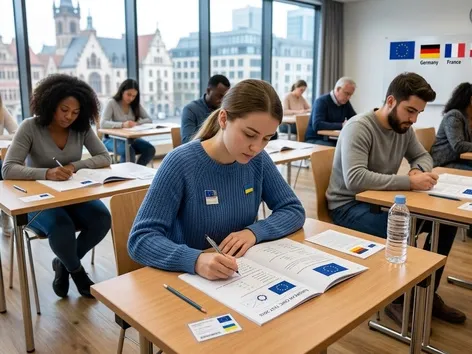
The path to citizenship in Europe has become much more difficult in 2026 - and it's not just about years of residence. Find out which countries have mandatory civics tests and integration exams, how requirements have changed in France, Poland, the Czech Republic, Germany and other countries, and what you need to check before applying for naturalization

Obtaining citizenship in Europe in 2026 is no longer just about waiting the right number of years and collecting papers. Most EU countries have rethought the approach to naturalization: now it is not only important how long a person has lived legally, but also how much they have actually become part of society. Language, knowledge of laws, understanding of the state system, basic values, rights and obligations of a citizen - all this has turned from a formality into a key condition.
This is precisely why most countries have civic tests - standardized exams in social knowledge. They check whether a person is oriented in the political system, institutions, culture and everyday rules of the country of residence. It is important not to confuse them: a civic test and a language test are different things. Language shows whether a person can communicate in the country. A civic test - whether he understands how this country functions.
Find out how civic tests have changed the procedure for obtaining citizenship in Europe and tips on preparing for the exam in this material.
Complication of the procedure for obtaining citizenship in Europe is the main trend of 2026
The Swedish naturalization system, which was previously considered relatively liberal, is becoming stricter in 2026: it is planned to increase the period of residence from 5 to 8 years, as well as increase language and financial requirements. It is important that the tightening of requirements is not an isolated case, but a pan-European trend: states are making the path to a passport more structured, and the requirements for real integration are stricter.
In most EU countries, the civic test is either already in effect, or is being strengthened, or is changing its format. At the same time, the requirements depend not only on the country: the type of residence permit, period of stay, marital status, grounds for application and the specific naturalization procedure remain important.
Don't want to miss important updates and useful articles? Subscribe to our weekly newsletter!
Poland: The main requirement is a high level of language proficiency
In Poland, there has traditionally been no separate civic test for naturalization. The main requirement is confirmation of Polish language proficiency at level B1, fulfillment of conditions regarding the period of residence, income and absence of problems with the law.
That is, instead of one clear civic exam, something else is important here: how much the applicant is already integrated into Polish everyday life - through language, work, taxes and social ties.
Read also: The Polish leadership is actively discussing the strengthening of the procedure for obtaining citizenship - what could change for Ukrainians?
In 2025, more than 19 thousand foreigners received a Polish passport, most of whom are Ukrainians, details in this article.
Czech Republic: Two separate exams
The Czech Republic remains one of the most formalized countries in terms of naturalization. The applicant here takes two separate exams: a language and a civic test:
- The language test tests reading, writing, listening and speaking.
- The civic component covers the constitutional system, government bodies, administrative structure, basic historical events, culture, traditions and everyday life. For many, this is the most difficult part: it requires not just memorizing facts, but also understanding how the system works.
In 2026, the Czech Republic maintains a high level of requirements, so those planning to apply should allow extra time for registration and preparation.
Read more about the current deadlines, naturalization rules and stages of obtaining a Czech passport in this article.
Germany: Einbürgerungstest plus a full integration check
In Germany, naturalization requires the mandatory passing of the Einbürgerungstest - a standardized test that covers basic political, legal and social topics. Separately, it is necessary to confirm the level of German, a sufficient period of legal residence, financial independence and the absence of serious offenses.
In 2024, Germany allowed dual citizenship, which was a significant step towards foreigners. However, overall, the requirements remain serious, and the discussion around accelerated naturalization paths in 2025–2026 continues.
France: New mandatory exam and increased fees from 2026
In 2026, France became one of the most striking examples of increased integration requirements. From January 1, 2026, a mandatory civic exam (Examen civique) was introduced - and it concerns not only naturalization, but also obtaining a long-term residence permit.
Language requirements are also differentiated: for a long-term permit (2-4 years), level A2 is required, for a 10-year resident card - B1, and for naturalization from 2026 - already B2.
The civic test itself consists of 40 questions, lasts 45 minutes. To pass, you need to give at least 32 correct answers. The topics cover the principles of secularism, gender equality, human rights, the functioning of state institutions, as well as knowledge of republican values and the basics of everyday life.
It is worth considering the increase in administrative fees separately: the first issuance of a carte de séjour or carte de résident has increased to 350 euros, the naturalization fee has increased to 255 euros.
Netherlands: Not one test, but a whole program - inburgering
In the Netherlands, the system is built around the inburgering procedure - it is not one test, but a comprehensive program that includes language modules, the KNM test (testing knowledge of Dutch society and its institutions), and in some cases - additional elements related to employment or civic participation. Before submitting, it is important to check the current format of the procedure, as it may change.
Belgium: 1,000 euros fee and a complicated regional system
In Belgium, the requirements have become stricter in 2026: the registration fee has increased to 1,000 euros. At the same time, the Belgian system is complicated due to the federal structure of the country - some integration issues are resolved at the regional level. Before applying, you should check not only the general requirements, but also the local procedures of your region regarding language level and integration courses.
United Kingdom: Life in the UK Test – no changes, but with nuances
In the United Kingdom, naturalization still requires passing the Life in the UK Test – a standardized exam on questions about British history, society, institutions and civic principles. Additionally – confirmation of English language skills and fulfillment of requirements regarding the period of residence and the absence of long-term departures. In 2026, these rules remain in force.
Read how Ukrainians can move to the United Kingdom in 2026 in this material.
Ireland: No exams – and this is not a mistake
Ireland remains one of the few exceptions in Europe – there is no separate language or civic exam for naturalization here.
The main criteria: period of legal residence, continuity of stay before application, clean reputation and intention to maintain contact with Ireland. For many applicants, this predictability makes Ireland one of the most obvious paths.
Read about EU countries where you can obtain citizenship through repatriation here.
What to check before applying for European citizenship in 2026?
The main rule for all countries: do not use outdated tables and old cheat sheets. Migration legislation changes rapidly, and what was relevant a year ago may no longer work today - especially for Ukrainians, whose status in a number of countries was regulated by separate laws that are gradually being abolished.
Before applying, be sure to check:
- Current language proficiency requirements (A2, B1 or B2 depending on the country and type of permit).
- Current civics exam format and topics tested.
- Legal residence period for your status.
- Income and financial independence requirements.
- Current state fees.
- List of documents for your specific applicant category.
Naturalization rules in Europe are changing so rapidly that even a careful study of current sources does not guarantee a complete picture – especially when it comes to your specific status, terms of stay and country of application. This is where a migration lawyer is indispensable: a specialist who knows not only the general rules, but also the intricacies of the procedures for different categories of applicants with different migration statuses.
A lawyer will help you determine which path to citizenship or residency is right for you, what documents are required in your case, whether your stay counts towards the required period – and how to avoid mistakes that can cost months of waiting or rejection. He will also guide you through the process of preparing for the civics test and language exam, help with submitting an application and communicating with migration authorities.
If you already live in Europe and are thinking about long-term status or citizenship – do not delay a consultation. The 2026 migration legislation sets new conditions, and it is better to learn about them in advance than to face a refusal due to a detail that could have been foreseen.
Schedule a consultation with a migration lawyer today – and take the first step towards a secure future in Europe.

Reminder! Portugal has officially tightened the rules for obtaining citizenship for foreigners. Now most migrants, including Ukrainians, will have to live in the country for at least 10 years instead of 5. We have already talked about the new requirements for naturalization, who will be affected by the changes and whether they will affect already submitted applications.
Photo – generated by Gemini
Want to know more? Read the latest news and useful materials about Ukraine and the world in the News section.
Our recommendation for a safe and comfortable trip:
Visit Ukraine Insurance - insurance for a safe stay abroad without unnecessary expenses;
Green Card - compulsory car insurance for traveling abroad;
Visit Ukraine Tickets - book tickets for buses, trains, and airplanes to/from Ukraine and between cities around the world;
Private Lawyer service - professional legal support on visa and migration issues;
Visit Ukraine Merch - buy patriotic clothing and accessories with worldwide delivery.
© 2018-2026, Visit Ukraine. Use, copying or reprinting of materials on this site is permitted only with a link (hyperlink for online publications) to Visit Ukraine.
All rights reserved.
Recommended articles
2 min
Popular
In which countries can a child obtain citizenship by birth in 2026?
Citizenship rules for children born to foreign nationals vary significantly from country to country. In some countries, a child automatically becomes a citizen by virtue of being born on the country’s territory, while in others, the parents must have resided there for a certain period or meet additional requirements. Learn more about which countries follow the jus soli principle and what rules apply in 2026
19 May. 2026
More details3 min
Emigration
Canada remains one of the most popular countries for Ukrainians to emigrate to in 2026. With its high standard of living and stable economy, the country offers many opportunities for those who want to start a new life abroad. Find out what the entry rules are for Ukrainians travelling to Canada in 2026, whether Ukrainians need a visa to enter Canada, what opportunities are available for relocation, and how to legalise your stay in the country after arrival
11 Jan. 2026
More details2 min
Emigration
How many years do you need to live in Poland to obtain citizenship: new requirements for Ukrainians
Poland plans to tighten the conditions for foreigners to obtain citizenship. Find out how many years you now need to live in the country to be eligible for citizenship
01 Oct. 2025
More details2 min
Documents
Multiple citizenship in Ukraine: what has changed since the new law came into force
A law on multiple citizenship has come into force in Ukraine, changing the rules for Ukrainians and foreigners. Find out which countries allow multiple passports, what the restrictions are, and what this means in practice
24 Jan. 2026
More details