


.gif)
How to Travel Abroad with Medication in 2026: Rules, Documents and Essential Tips for Travelers
- Why can transporting medications cause difficulties?
- Where to transport medications: in hand luggage or luggage?
- Why should you not transfer pills to other packaging?
- What documents do you need to take with you?
- Features of transporting liquid medications
- Controlled drugs: what should you check in advance?
- How to prepare a travel first aid kit in 2026?
- How to avoid problems at the border?
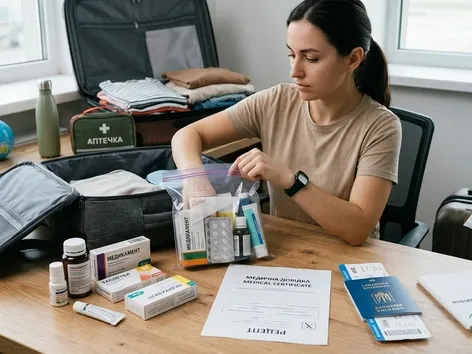
Traveling with medication requires careful preparation and knowledge of customs and aviation regulations. Learn how to properly transport medication abroad in 2026, what documents you may need, and how to avoid problems when going through airport security

Preparing for a trip usually includes booking tickets, choosing a hotel, and planning an itinerary. At the same time, many tourists put off the issue of transporting medications until the last minute, although this very detail can cause trouble when passing customs or border control.
According to pharmacists and tourism industry experts, most problems with medications arise not because of complex international rules, but because of banal mistakes during packaging or the lack of necessary documents. In 2026, when many countries are tightening control over the import of medications, the issue of proper transportation of medications becomes even more relevant.
Planning a trip abroad? Get reliable medical insurance on the Visit Ukraine portal.

Why can transporting medications cause difficulties?
Each country has its own requirements for importing medications. A drug that is freely sold in one country may belong to the category of controlled substances in another or require special permission.
Customs services pay special attention to:
- Strong painkillers;
- Medicines containing narcotic or psychotropic substances;
- Sedatives;
- Injectable medications;
- Large volumes of medications.
That is why it is important to check the requirements of the destination country and transit countries in advance before traveling, if the route involves transfers.
Don't want to miss important updates and useful articles? Subscribe to our weekly newsletter!
Where to transport medications: in hand luggage or luggage?
Experts unanimously recommend transporting the main supply of medications in hand luggage.
There are several reasons for this. Firstly, checked baggage can get lost or delayed. Secondly, the optimal temperature conditions for storing individual medications are not always maintained in the cargo compartment of the aircraft.
If you regularly take certain medications, they should be available throughout the flight and immediately upon arrival at your destination.
At the same time, experts advise leaving a small supply of medications in your luggage. Such a supply can be useful in case of unforeseen situations.
Read here what you can import or export to/from Ukraine and which goods are subject to prohibitions or restrictions.
Why should you not transfer pills to other packaging?
One of the most common mistakes tourists make is transferring pills into travel containers or plastic organizers without factory markings.
At the border or during security checks, airport staff must be able to quickly identify the drug. The lack of original packaging can cause additional questions and delays.
Therefore, it is advisable to transport all medications in their original packaging, with the manufacturer's label and indicating the name of the drug and dosage.
Read our previous article on what medications can be imported into Poland in 2026.
What documents do you need to take with you?
In many cases, it is enough to have the standard packaging of the drug. However, if we are talking about prescription or controlled drugs, it is worth preparing additional documents.
It is recommended to have:
- A copy of the doctor's prescription;
- Medical certificate in English;
- Extract with the diagnosis (if necessary);
- Document with a list of medications and dosage.
It is advisable to indicate the international non-proprietary name of the drug in the certificate, as trade names may differ depending on the country.
Analogues of Ukrainian drugs in Germany in this material.
Features of transporting liquid medications
Special attention should be paid to liquid medications.
Most airports have standard rules for transporting liquids in hand luggage. However, medications are often an exception. If the volume of the drug exceeds 100 ml, the passenger may be allowed to carry it provided that there are supporting medical documents.
To avoid misunderstandings, liquid medications must be kept in an easily accessible place and be ready to present them during a separate check.
Controlled drugs: what should you check in advance?
Special rules apply to medications that contain narcotic or psychotropic components. This category may include certain sleeping pills, sedatives, and strong analgesics.
Before traveling, you should:
1. Check the legislation of the country of destination.
2. Clarify the requirements of transit countries.
3. Obtain an official certificate from a doctor.
4. If necessary, obtain a special permit to import the drug.
In some countries, the lack of necessary documents can lead not only to the confiscation of drugs, but also to administrative liability.
How to prepare a travel first aid kit in 2026?
In addition to the drugs that a person takes regularly, it is worth having a basic first aid kit when traveling.
It usually includes:
- Antipyretics and painkillers;
- Drugs for digestive disorders;
- Antihistamines;
- Plasters and antiseptics;
- Medicines for motion sickness;
- Medicines for chronic diseases with a supply for a few extra days.
This is especially important for trips to remote regions, islands or countries where access to usual medicines may be limited.
Where and how to look for medicines abroad in 2026 was discussed in this material.
How to avoid problems at the border?
The main rule for tourists in 2026 is not to leave the issue of transporting medicines to the last day.
Before traveling, it is recommended to:
1. Check the rules for importing medicines into the country of destination;
2. Store medicines in their original packaging;
3. Prepare the necessary medical documents;
4. Carry the main supply of medicines in hand luggage;
5. Clarify the airline's requirements in advance.
A little preparation will help you avoid delays at security, confiscation of medications, or other troubles that can ruin your vacation or business trip.
When traveling, it is important to take care not only of your tickets and documents, but also of your own safety. Medical insurance for traveling abroad will help you avoid significant expenses in the event of illness, injury, or other unforeseen situation. The policy can cover doctor's consultations, diagnostics, hospitalization, medications, emergency dental care, and medical evacuation. Insurance is especially relevant for long trips, work, or study abroad.
Apply for medical insurance online at Visit Ukraine in a few minutes and travel the world with confidence in your own protection.
Reminder! The rules for access to medicine for Ukrainians are gradually changing in EU countries. We have already told you which medical services for refugees in Europe remain free, and which you increasingly have to pay for yourself.
Photo - generated by Gemini
Want to know more? Read the latest news and useful materials about Ukraine and the world in the News section.
Our recommendation for a safe and comfortable trip:
Visit Ukraine Insurance – insurance for a safe stay abroad without unnecessary expenses;
Green Card – compulsory car insurance for travelling abroad;
Visit Ukraine Tickets – book tickets for buses, trains, and planes to/from Ukraine and between cities around the world;
Private Lawyer service – professional legal support on visa and migration issues;
Visit Ukraine Merch – purchase patriotic clothing and accessories with worldwide delivery.
© 2018-2025, Visit Ukraine. Use, copying or reprinting of materials on this site is permitted only with a link (hyperlink for online publications) to Visit Ukraine.
All rights reserved.
Recommended articles
2 min
Health
Toothache Abroad: How Much Does a Dentist Cost in Europe in 2026 and How to Avoid Overspending
Dental care abroad can cost several times more than in Ukraine, especially without insurance coverage. Find out how much fillings, cleanings, and tooth extractions will cost in 2026 in Poland, the Czech Republic, and Germany, and how to reduce costs for emergency treatment
21 Mar. 2026
More details2 min
Health
Once Ukraine is integrated into the European cross-border healthcare system, Ukrainians will be able to receive reimbursement for medical treatment abroad. The draft bill has already been prepared and is up for discussion. Find out how the new system will work
16 Mar. 2026
More details2 min
Travel
Europe's Sunniest Beaches in 2026: Top 10 Resorts with the Least Summer Rain
Experts at hoppa have identified the sunniest beaches in Europe with the least amount of summer rainfall. Find out which resorts in Cyprus, Greece, Spain, and Portugal made the top 10 and where summer sunshine is practically guaranteed
13 Jun. 2026
More details2 min
Travel
Gastronomic tourism in 2026: the world’s 20 best cities for the most delicious food
Time Out’s latest ranking lists the 20 best destinations for foodies in 2026: from Bangkok’s street food to Barcelona’s fine dining. Find out which city tops the global ranking
12 Jun. 2026
More details